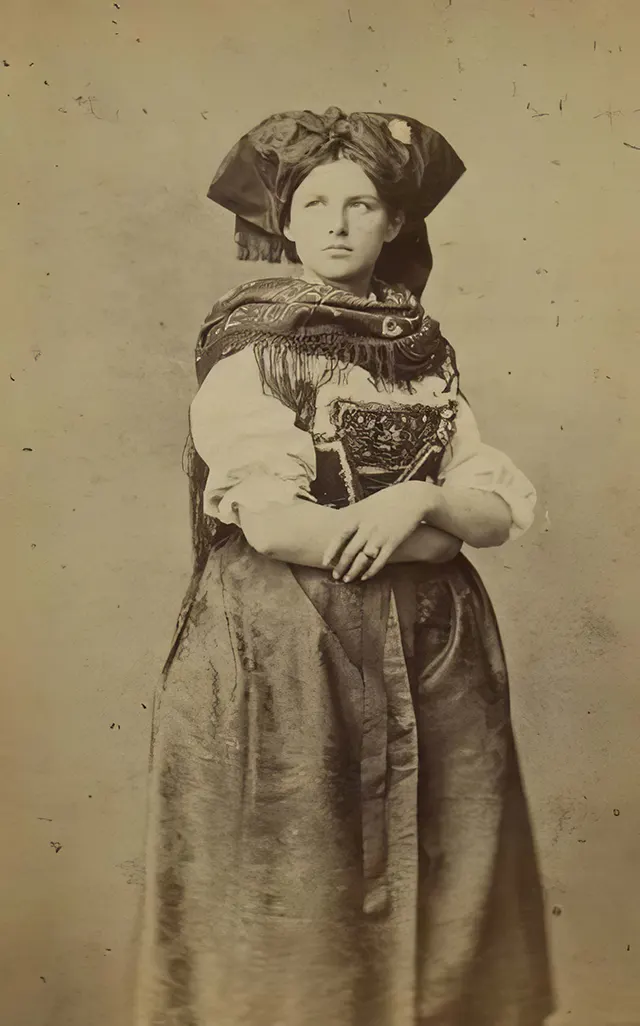
Poised against a plain studio backdrop, a young woman wears traditional Alsatian dress with an unmistakable Schlupfkapp framing her face in a wide, structured silhouette. The headpiece—dark, crisp, and carefully arranged—draws the eye upward, while her calm, slightly distant gaze gives the portrait a quiet authority. Around her shoulders, a patterned shawl with long fringe is wrapped for warmth and display, adding texture and movement to the otherwise still composition.
Her outfit reads like a catalogue of regional craftsmanship: a fitted bodice with ornate detailing over a white blouse, and a full skirt that falls in heavy folds. The careful layering suggests clothing meant for ceremony as much as daily life, where fabric, cut, and ornament signal community ties and local identity. Even without a named place or date, the styling strongly evokes Alsace’s well-known folk costume tradition and the way women’s attire became a visual marker of belonging.
Schlupfkapp imagery endures because it sits at the crossroads of fashion and cultural heritage, turning a practical head covering into a symbol recognized far beyond its region. Studio portraits like this helped fix the costume in public memory—part documentation, part idealization—at a time when traditional dress could signify pride, continuity, and resistance to cultural erasure. For readers searching Alsatian identity, regional costume, or historic European folk fashion, this photograph offers a striking, human-scale entry point into the story of the Schlupfkapp through the ages.