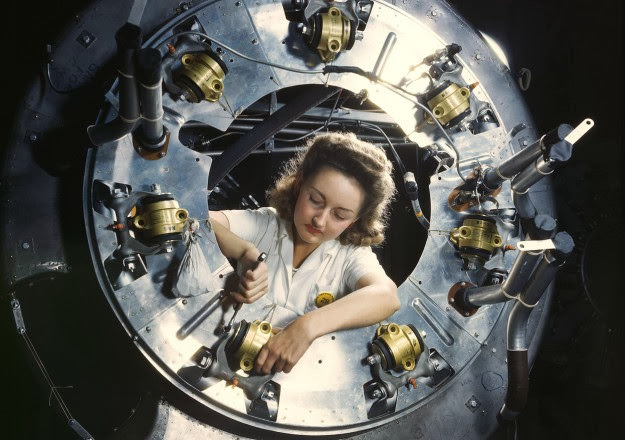
Framed by the bright ring of metal, a factory worker leans into the circular opening of a B-25 bomber engine cowling, hands busy with a tool as fittings and fasteners catch the light. The colorization emphasizes the polished surfaces and the dense, mechanical rhythm of the assembly—components repeating around the circumference like a clockwork halo. It’s an intimate angle on aircraft manufacturing, pulling the viewer close to the precision that made wartime aviation possible.
At North American Aviation’s Inglewood, California, plant in 1942, the work of building combat aircraft depended on painstaking sub-assemblies like this one, where airflow management and engine access mattered as much as raw power. The cowling’s structure hints at the careful engineering behind the B-25 Mitchell’s reliability: sturdy panels, evenly spaced hardware, and a design meant to be assembled, inspected, and serviced at speed. Industrial production is often remembered in sweeping numbers, yet here it resolves into the tactile reality of metal edges, torque, and alignment.
Seen today, the scene offers more than a technical snapshot—it’s a reminder that the story of World War II aircraft is also the story of factory floors and the people who mastered them. The close-up perspective spotlights the craft of assembly-line aviation, where thousands of similar tasks combined into a finished bomber ready for the runway. For readers exploring B-25 production, North American Aviation history, or WWII home-front industry, this photograph provides a vivid, human-scale view of 1942 manufacturing.