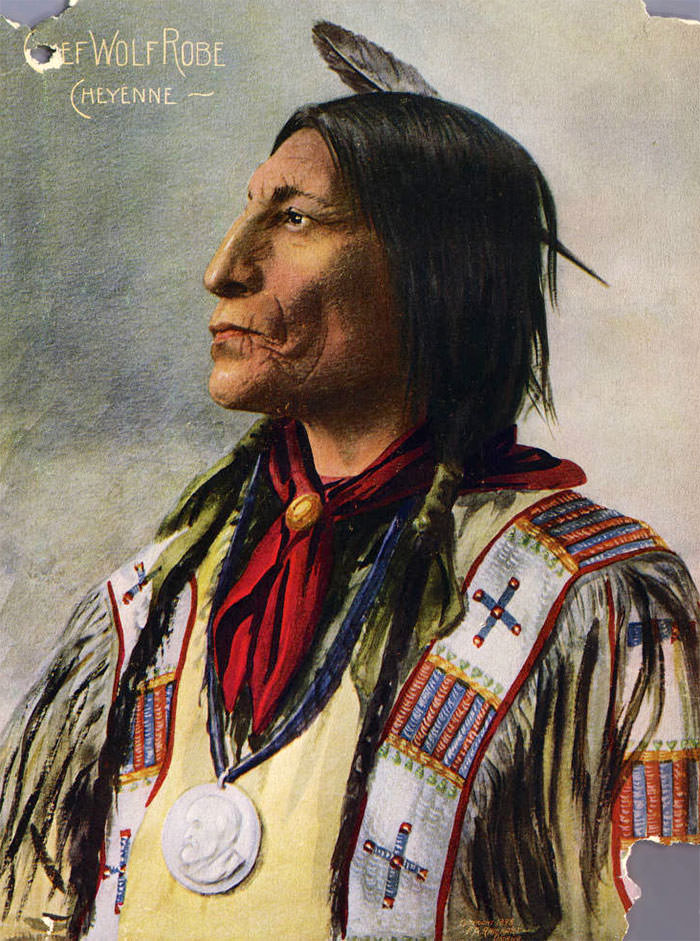
Profiled against a soft, neutral backdrop, Chief Wolf Robe of the Cheyenne is rendered with a quiet authority that draws the eye to his expression and bearing. The artist emphasizes his long dark hair, a single feather rising above the crown, and the strong line of his nose and jaw, shaping a portrait that feels both intimate and formal. Hand-lettered text in the corner identifies him plainly, anchoring the viewer in the subject rather than the setting.
Color halftone reproduction gives the piece its distinctive early-print character, translating a painting made from an F. A. Rinehart photograph into dot-patterned color meant for wide circulation. The reds of the neckcloth, the beaded decorations, and the bright white medallion at the chest stand out, suggesting how turn-of-the-century publishers used colorization to heighten detail and appeal. Along the margins, the worn edges and small losses in the paper remind us that this is a surviving artifact as much as it is an image.
As a historical portrait from 1898, the work sits at the crossroads of photography, painting, and mass printing—three mediums that helped shape how Native leaders were seen by distant audiences. It invites a slower look at material culture in the clothing and adornments while also prompting questions about authorship, reproduction, and the intent behind circulating such portraits. For readers searching Cheyenne Chief Wolf Robe, F. A. Rinehart, or color halftone prints, this post offers a vivid glimpse into how an original photograph could be transformed into a widely shared, enduring likeness.