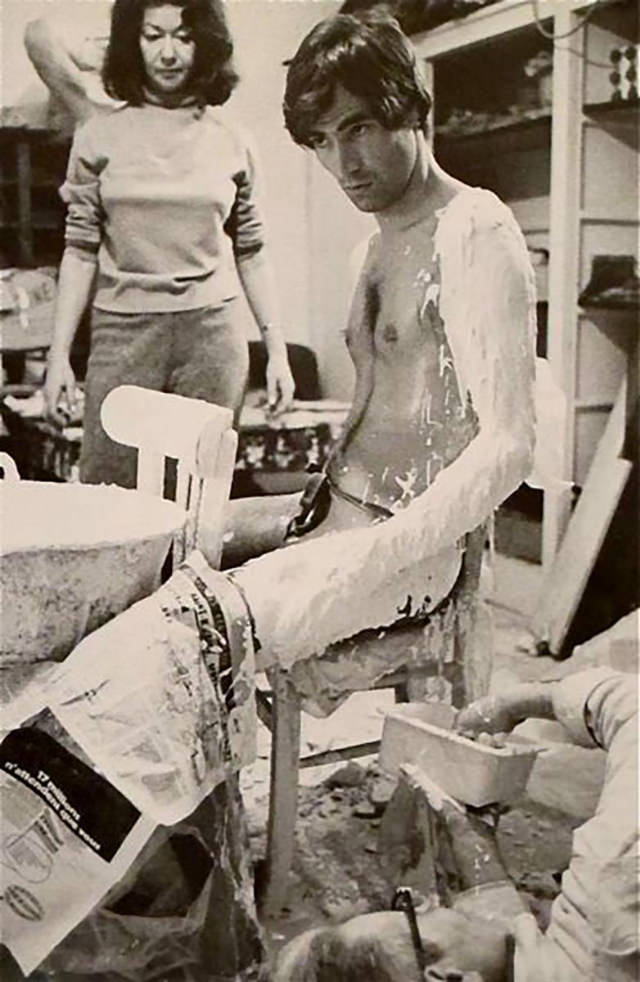
In a cluttered studio setting, a shirtless male model sits rigidly while wet plaster is worked over his torso, turning an ordinary body into a temporary mold. A woman stands nearby with the focused, supervisory posture of someone used to directing process as much as posing—an art-world collaboration caught mid-step rather than dressed up for the camera. Bags and buckets of casting material crowd the foreground, reinforcing the hands-on, workshop reality behind an object that would later read as sleek design.
Ruth Francken’s Homme Chair belongs to that provocative moment when furniture, sculpture, and conceptual art began to overlap, and the human figure could be treated as both subject and structure. The photograph hints at the transformation: a living person patiently offering their form to be copied, refined, and translated into a functional object. Seen through the lens of design history, it’s also a document of invention—materials, labor, and artistic intent converging to make a seat out of anatomy and idea.
Details like the plastic sheeting, smeared plaster, and improvised supports underscore how experimental design often starts with mess and uncertainty. For readers searching the story of the Homme Chair, Ruth Francken, or body-cast furniture, this image provides a rare behind-the-scenes glimpse of the process that turned a model’s backside into a work of art. The result is less about novelty than about authorship and the era’s bold question: where does the human body end and an object begin?