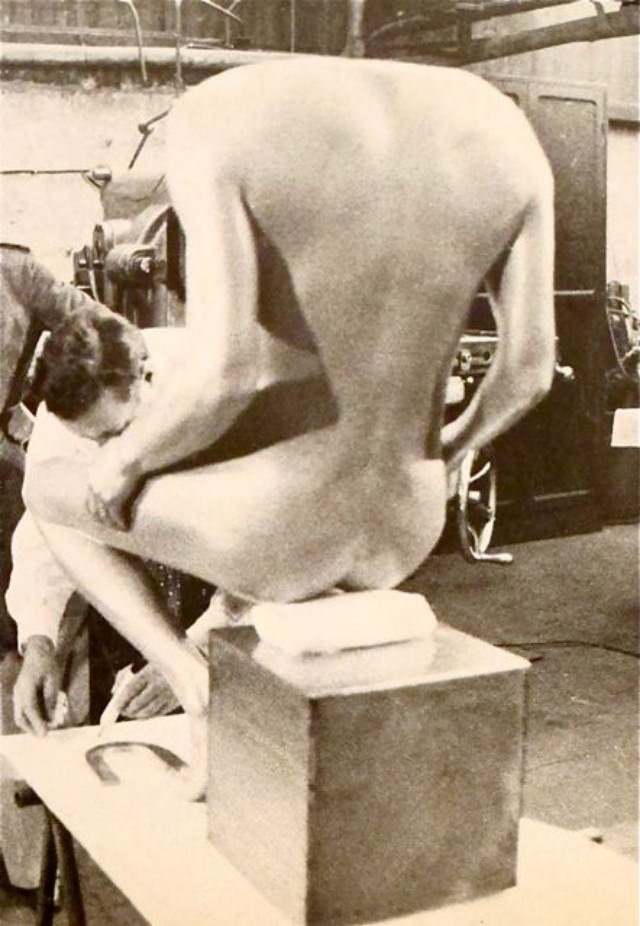
A nude model sits in profile atop a plain cube, knees drawn up and arms relaxed, while a technician crouches nearby as if taking measurements or shaping a mold. The studio setting—tools, cables, and equipment receding into the background—reads less like a gallery and more like a workshop, where the human body becomes both subject and raw material. It’s an arresting scene because it blurs the line between life drawing and industrial process, turning a private pose into a public experiment in form.
Ruth Francken’s “Homme Chair” legend hangs over the moment: a piece of design history in which anatomy is translated into furniture, and a model’s backside becomes an object you can live with. The photograph hints at that transformation, with the improvised pedestal and the careful attention to contours suggesting casting, sculpting, or prototyping rather than simple portraiture. Seen through the lens of mid-century invention culture, it’s a reminder that modern design often chased the provocative—making comfort, humor, and scandal share the same seat.
In the wider story of art-meets-industry, images like this serve as evidence of how radical ideas were physically built, not merely sketched. For readers searching design history, Ruth Francken, or the origins of iconic novelty furniture, the photo offers a tangible look at process: bodies posed, surfaces tested, and new objects negotiated into existence. Whatever one thinks of the concept, the workshop atmosphere underscores the real craft behind the provocation—an invention staged on a simple block, measured in patience and plaster as much as in imagination.