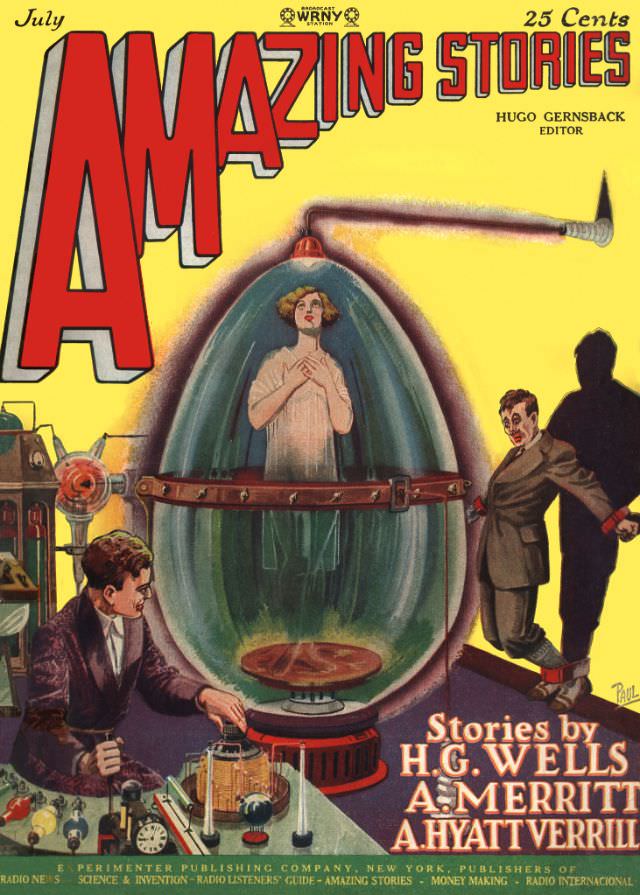
Bold lettering shouts “Amazing Stories” across a bright yellow field on this July 1927 cover, priced at 25 cents and edited by Hugo Gernsback. The design is pure early pulp energy: oversized typography, dramatic illustration, and the promise of scientific wonder packaged for the newsstand. Even the small print and station callout near the masthead hint at the era’s fascination with radio and modern invention.
At the center, a woman stands upright inside a glassy, egg-shaped chamber, hands clasped as if bracing for an experiment—or a spectacle. A metal band clamps across the vessel’s midsection, while wires, gauges, and tabletop apparatus crowd the foreground, suggesting a laboratory set-up teetering between credible engineering and theatrical showmanship. To the right, two men—one in the light, one rendered as a looming shadow—add tension, turning the scene into a cliffhanger frozen in ink.
Pulp magazine cover art like this helped define what “science fiction” looked and felt like in the 1920s: high-stakes technology, perilous curiosity, and a dash of melodrama. The bottom text touts stories by H. G. Wells, A. Merritt, and A. Hyatt Verrill, anchoring the sensational imagery to recognizable genre names. For collectors and historians alike, the July 1927 Amazing Stories cover remains a vivid snapshot of how popular culture imagined science—beautiful, intimidating, and just plausible enough to be thrilling.