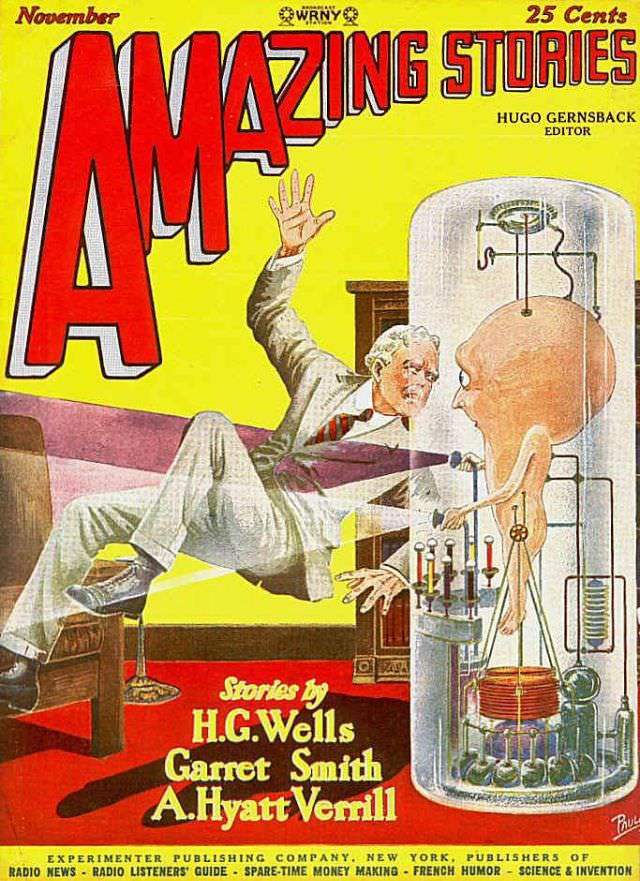
Bold reds and sunny yellows shout from the November 1927 cover of *Amazing Stories*, where oversized lettering frames a scene of scientific peril and pulp-era wonder. A startled man in a light suit tumbles backward across a room, one hand thrown up as if to shield himself from what’s unfolding beside him. The composition is pure early science fiction magazine drama—immediate, theatrical, and designed to stop a newsstand browser in their tracks.
At the right edge, a large glass apparatus dominates the foreground, part laboratory display and part nightmare: a human head and partial figure appear suspended within, surrounded by coils, tubes, dials, and small instrument posts that suggest electricity and experiment. The artist plays with scale and transparency so the machinery feels both clinical and uncanny, turning the glass cylinder into a stage where modern science becomes spectacle. That contrast—domestic furniture on the left, futuristic equipment on the right—captures the genre’s favorite tension between everyday life and the unknown.
Details printed on the cover anchor it firmly in magazine history, including the issue month, the 25-cent price, and editor credit to Hugo Gernsback, with author names such as H. G. Wells featured prominently. For collectors and readers alike, this cover art reflects the visual language that helped define early American science fiction: sensational invention, crisp typography, and a promise of strange new ideas inside. As a piece of vintage pulp illustration, it’s an evocative snapshot of how 1920s popular culture imagined technology—equal parts progress, menace, and amazement.