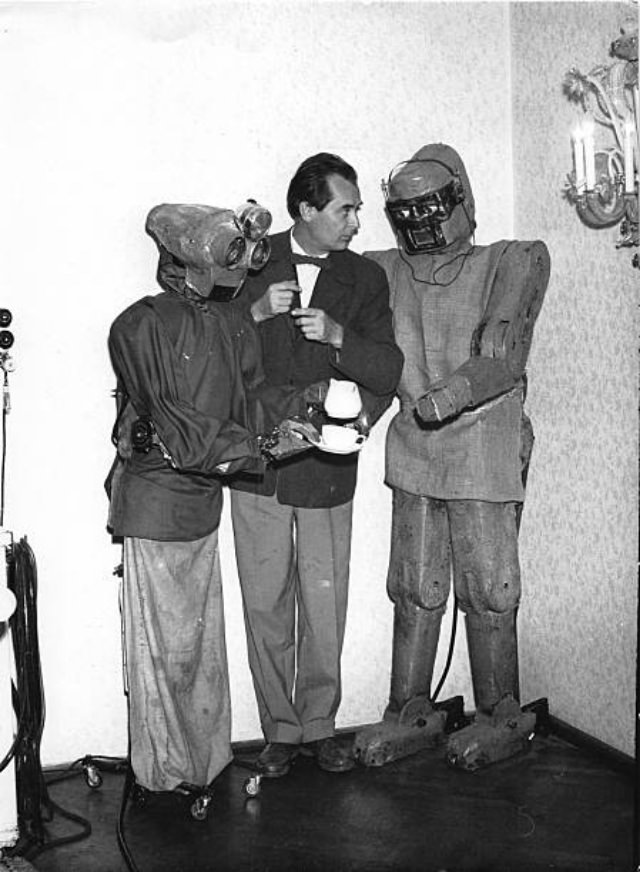
Between two bulky, human-shaped machines, a sharply dressed demonstrator pauses as if in mid-conversation, turning his head toward the towering “robot” figures beside him. The scene plays out like a salon showpiece: a chandelier glints above, a smooth wall frames the trio, and cables and wheels hint that these mechanical helpers are as much engineering experiment as spectacle. Even without technical close-ups, the photo communicates a familiar promise of the modern age—housework transformed into something you can delegate to a device.
Claus Scholz-Nauendorff’s MM7 Selektor Robot, as the title suggests, belonged to a period when inventors and promoters blurred the line between appliance, automaton, and theatrical demonstration. The robots’ oversized boots, stiff arms, and helmet-like heads suggest protective housings and practical constraints, while their near-human posture sells the dream of domestic assistance. That tension—between what machinery could really do and what audiences wanted it to do—sits at the heart of early household robotics and mid-century invention culture.
For WordPress readers interested in the history of technology, this historical photo offers a vivid entry point into how “labor-saving” innovations were marketed long before today’s smart home devices. It’s an evocative snapshot of domestic automation’s imagination phase, when a selector robot could be presented as a household partner rather than a simple machine. Seen now, the MM7 Selektor Robot stands as both artifact and metaphor: a reminder that the future of housework has always been as much about storytelling as it is about engineering.