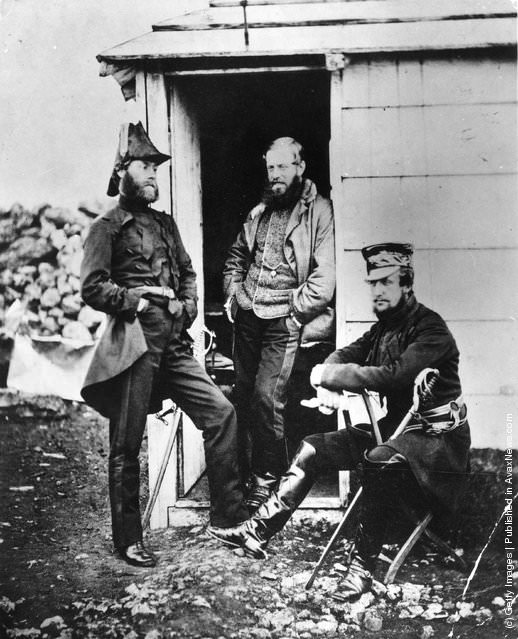
Three officers linger beside a rough wooden hut, their poses relaxed but watchful, as if a brief pause has been stolen from a day of dispatches and decisions. One stands in profile with hands near his belt, another leans into the doorway in heavier outerwear, and a third sits forward on a camp chair, legs crossed, framed by the practical clutter of field life. The sparse setting—rocky ground, plain boards, and hard light—speaks to a campaign where comfort was improvised and routines were shaped by weather, logistics, and the next order.
Rather than a staged parade-ground portrait, the scene feels like staff work made visible: men close to command, dressed in service uniforms and caps, caught between movement and rest. Details like the seated officer’s posture and the easy lean of the man in the doorway suggest familiarity with one another and the informal hierarchies of a headquarters in the field. For readers interested in the Crimean War, the photograph offers a grounded look at how British military officers appeared and carried themselves during the 1850s campaign.
Behind the title’s reference to Lt. General Sir G. Brown lies the larger story of mid-19th-century warfare, when modern photography began documenting not only battles but also the people who managed them. Images like this help bridge official history and lived experience, highlighting the everyday texture of a military staff—uniforms, shelter, and the human need to sit, lean, and endure. It’s a valuable visual record for anyone exploring Crimean campaign history, British Army leadership, and wartime life beyond the front line.