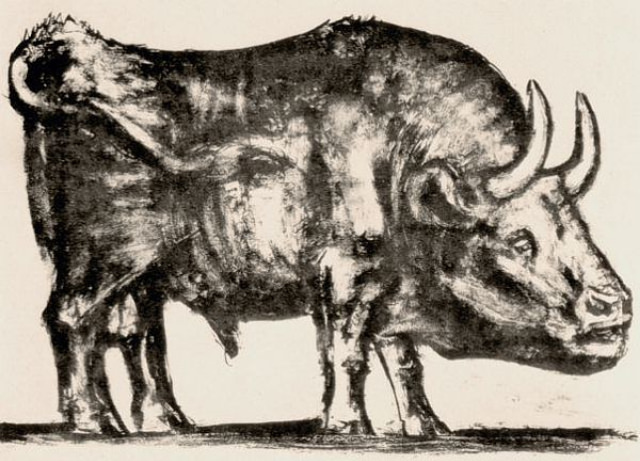
Bold, weighty contours push the bull forward in Plate 2, where the animal’s mass feels newly asserted and deliberately monumental. The lithographic marks thicken around the torso and shoulders, turning the body into a compact block of force while still leaving the surface alive with grain, smudges, and scraped light. Even the ground line anchors the creature like a stage, making the stance read as both natural and emblematic.
Picasso’s second stage of the bull lithograph invites close looking at process: the incremental decisions that transform observation into symbol. The horns sharpen into confident arcs, the head gains a firmer profile, and the legs settle into a sturdier architecture, as if the artist is testing how far simplification can go without losing presence. In the shifting balance between shading and outline, the bull becomes less a single animal and more an idea—strength, endurance, and ritual power rendered in ink.
Between the rough textures and the tightened silhouette, this artwork offers a compelling glimpse into how a master drafts myth from matter. For readers interested in Picasso prints, lithography technique, and the evolution of form in modern art, Plate 2 stands as a vivid step in a larger sequence of transformation. The result is an expressive bull that feels heavier, more inevitable, and closer to the timeless figure that later stages will refine even further.