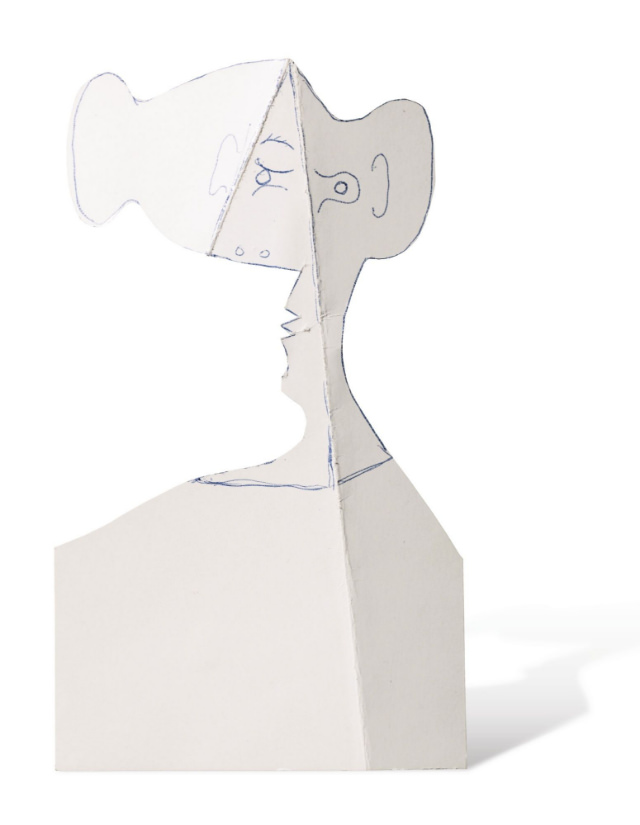
A profile emerges from almost nothing: pale paper folded into crisp planes, a single line sketching an eye, nose, and mouth, and a soft gray shape suggesting hair. The effect is both sculpture and drawing at once, as if the sheet has stepped off the page and into the room. In keeping with the post’s theme, “Paper Mosaics: Picasso’s Rare Cut-Paper Artworks,” the work relies on economy—few marks, minimal color, and a strong silhouette that reads instantly.
Look closer and the quiet ingenuity becomes the story: cuts create a stepped jawline, folds turn negative space into a cheekbone, and the simplest ink strokes animate a face with wit. The paper’s edges and seams are left visible, inviting attention to process rather than polish. That balance—playful abstraction anchored by recognizable human features—echoes the broader fascination with Picasso’s experiments in collage, cut-outs, and constructed forms.
For readers searching for Picasso cut-paper art, paper collage history, or modernist works on paper, this image offers an intimate doorway into an often-overlooked corner of the artist’s practice. It reminds us that innovation isn’t always loud; sometimes it’s a quiet manipulation of humble materials that rethinks what a portrait can be. In this post, the “paper mosaic” idea feels literal and poetic, capturing how fragments, folds, and lines can assemble into a presence.