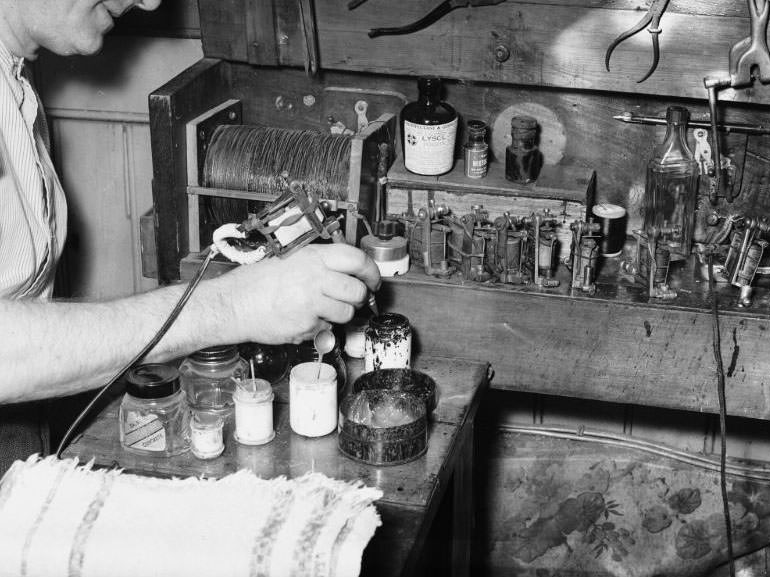
Workbench clutter tells its own story inside Fred Harris Tattoo Studio in Sydney, where the tools of the trade sit ready for use on 17 December 1937. A practitioner’s hand steadies an early electric tattoo machine while small jars—likely holding pigments, ointments, or cleaning compounds—line the bench in practical reach. The scene feels intimate and workmanlike, showing tattooing not as spectacle but as careful, repeatable craft.
Along the back shelf, rows of metal fittings and parts are stored like a miniature workshop inventory, hinting at the constant maintenance these instruments demanded. Coils, wires, and fittings suggest a studio that doubled as a repair bench, where equipment was tuned and kept reliable between clients. Even the everyday textures—wood grain, glass, and stained containers—add to the sense of a busy, lived-in workspace typical of interwar service businesses.
For readers interested in Australian social history, this photograph offers a rare look at the material culture of tattooing in 1930s Sydney, when studios relied on a blend of electrical know-how and steady hands. It’s also a reminder that tattoo “artworks” began with tools, supplies, and disciplined routines behind the scenes. As a piece of visual history, it helps ground the evolution of tattoo equipment and studio practice in the ordinary realities of work.