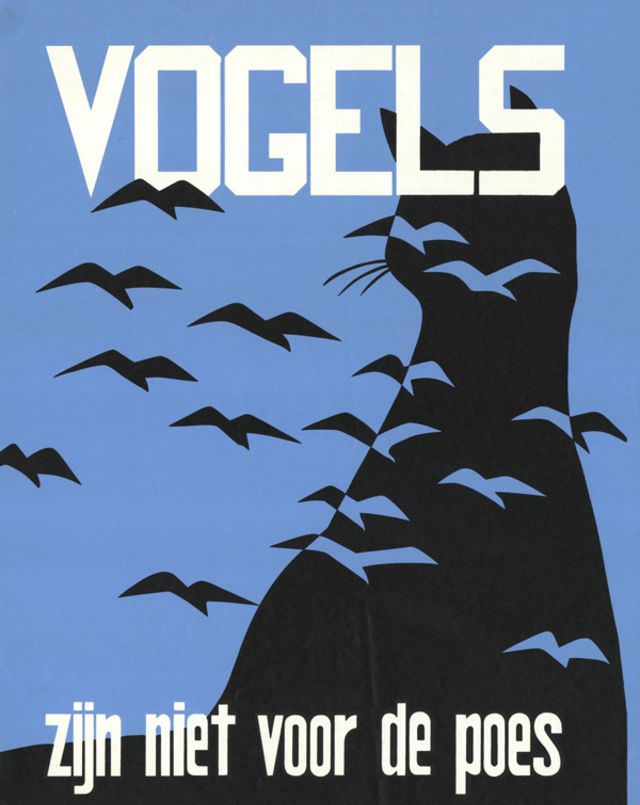
Bold lettering shouts “VOGELS” across a clear blue field, while a crowd of black, cut-paper birds sweeps diagonally through the frame. At right, a sleek feline silhouette rises like a shadow against the sky, its whiskers and curved profile reduced to the simplest possible lines. The Dutch phrase “zijn niet voor de poes” anchors the bottom edge, turning the poster into a punchline as well as a warning.
Dated 1968 and credited to an unknown designer, the artwork leans into the era’s love of strong contrast and immediate visual metaphor. The limited palette—blue, black, and white—makes the composition legible at a distance, the kind of graphic clarity meant for the street and the quick glance. By setting the birds in motion around the cat’s looming shape, the designer creates tension and humor without needing a single realistic detail.
For collectors and historians of 1960s graphic design, this piece sits comfortably among the period’s striking poster art and modernist typography. Its Dutch text, blocky type, and emblem-like silhouettes make it highly searchable for themes like vintage posters, animal motifs, and European design from the late sixties. Whether read as a playful proverb or a sharper commentary, “Designer unknown, 1968” remains a memorable example of how simple forms can carry a story.