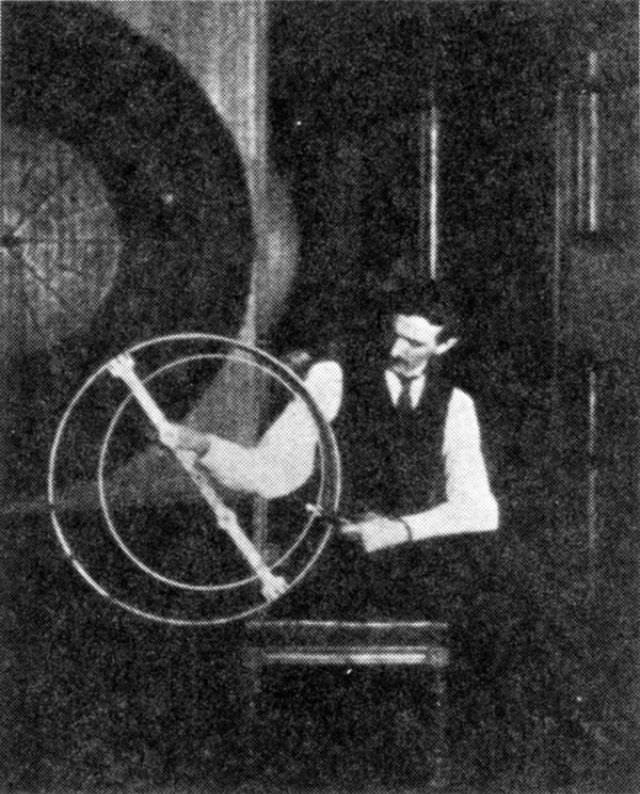
Across the dim laboratory scene, an experimenter in a vest and tie leans over a striking circular apparatus, its rings and angled arm suggesting a carefully tuned receiver rather than a simple classroom prop. The title points to a synchronized circuit—one designed to respond only when “in step” with a signal—hinting at the early craft of coaxing invisible waves into visible, measurable action. Even through the grain, the setup reads like a moment when wireless theory was being tested by hand, with brass, wire, and patience.
What makes this kind of demonstration compelling is the promise embedded in its wording: “energized by waves transmitted from a distant oscillator.” Long before radio became a household utility, engineers and inventors had to prove that a remote source could trigger a dependable response at the other end, not by contact but by resonance and timing. The circular frame evokes the language of coils and tuning, where matching frequencies could separate a desired signal from the surrounding electrical noise.
For readers interested in the history of inventions, early wireless communication, and the development of synchronized circuits, this photograph offers a textured glimpse into experimentation as performance—hands on the instrument, eyes on the effect. It invites modern viewers to imagine the room alive with faint hums and adjustments, as the operator searches for that precise condition where the distant oscillator’s waves “catch” and the circuit answers back. In that narrow window of synchronization lies a foundational idea behind radio tuning, remote control, and much of the signal technology that followed.