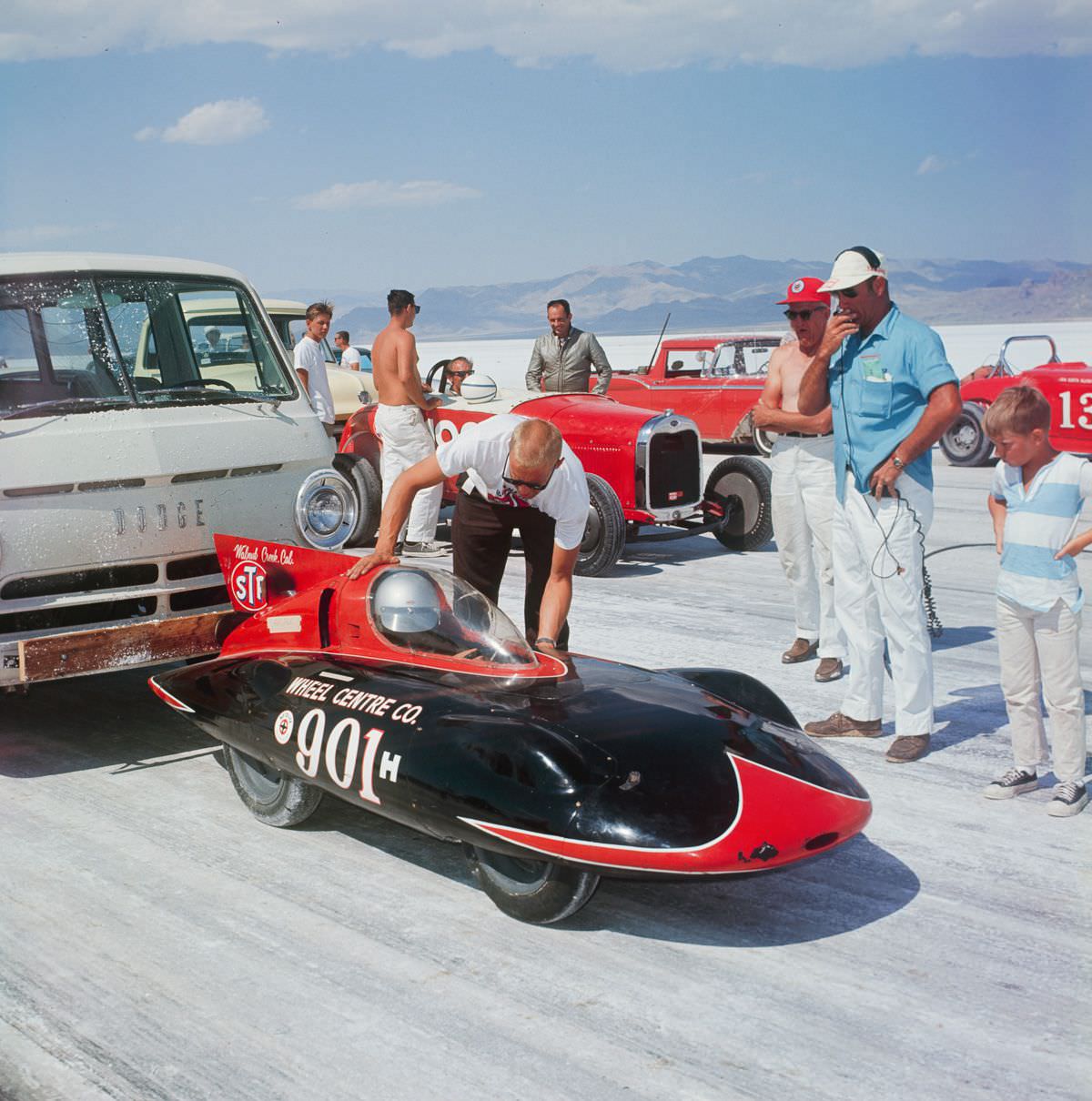
Salt stretches to the horizon under a hard blue sky as crews cluster around a low, needle-nosed streamliner marked “901 H” and “Wheel Centre Co.”, its red-and-black bodywork gleaming against the pale flats. A man leans over the cockpit bubble in last-minute preparation while other racers and spectators—shirt sleeves, caps, and sunburned shoulders—stand close enough to feel the heat shimmer. Nearby, a Dodge support vehicle and other competition cars hint at the bustle and improvisation that define land speed racing in its most iconic setting.
Donald Barr’s H-Class Streamliner is the quiet star here, built for one purpose: to slip through air with minimal resistance and turn mechanical grit into measured miles per hour. The small wheels tucked beneath the fairings, the narrow profile, and the tight canopy speak to the engineering logic of Bonneville, where even tiny improvements can decide a record. The title’s figure—145.92 miles per hour—lands not as abstract trivia, but as the payoff for careful tuning, teamwork, and nerve on a surface that looks smooth until you’re the one hurtling across it.
Around the machine, the photo captures the social world of the Bonneville Salt Flats Speed Trials: officials with cords and clipboards, rival cars waiting their turn, and families watching a technical ritual unfold in plain view. It’s a slice of mid-century American motorsport culture where innovation lived in garages and was tested in the open desert, far from grandstands. For readers searching land speed racing history, Bonneville streamliners, or H-Class record attempts, this scene delivers the human scale behind the numbers and the enduring romance of speed on salt.