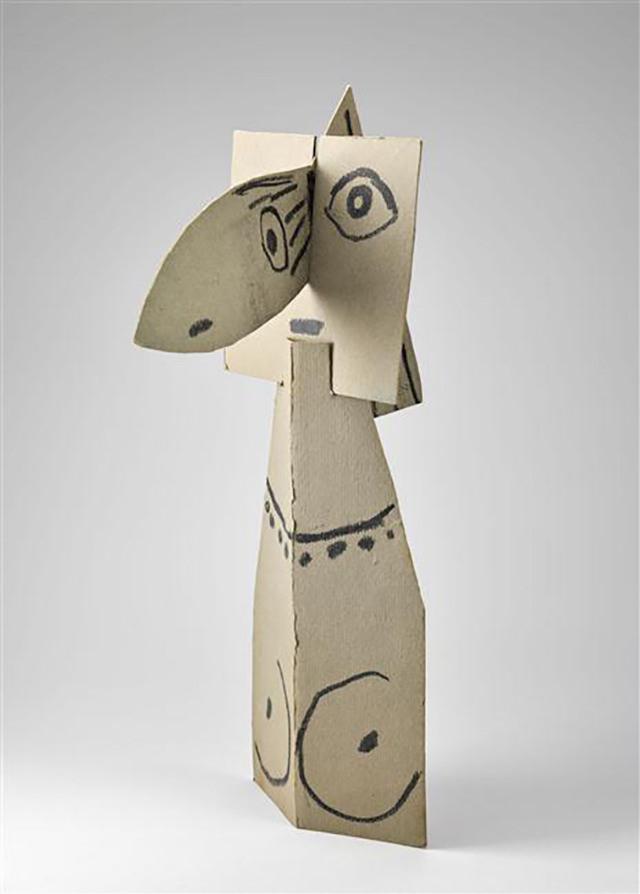
Angular folds and quick, confident lines turn humble paper into a small standing figure, its profile exaggerated into a long, mask-like nose and a wide, searching eye. The work balances between drawing and sculpture: flat planes meet at sharp creases, while a few dark strokes suggest features, jewelry, and the curve of a torso. In keeping with the spirit of “Paper Mosaics,” the material itself becomes part of the message—lightweight, fragile, and surprisingly bold.
Picasso’s cut-paper experiments reveal an artist endlessly testing how far an ordinary medium can be pushed. Here, the hand-cut shapes function like facets, creating a cubist rhythm without paint or heavy texture, and the simplest marks do the storytelling. The result feels playful yet deliberate, a rare glimpse into process and improvisation where scissors, folds, and ink lines stand in for traditional carving or modeling.
Readers interested in Picasso’s lesser-known works, modernist collage, and paper sculpture will find plenty to linger over in this post. The photographed artwork invites close looking: how the edges overlap, how negative space becomes structure, and how a few gestures can conjure personality. It’s a compact example of why cut-paper art remains so compelling—proof that innovation can start with nothing more than paper, a blade, and imagination.