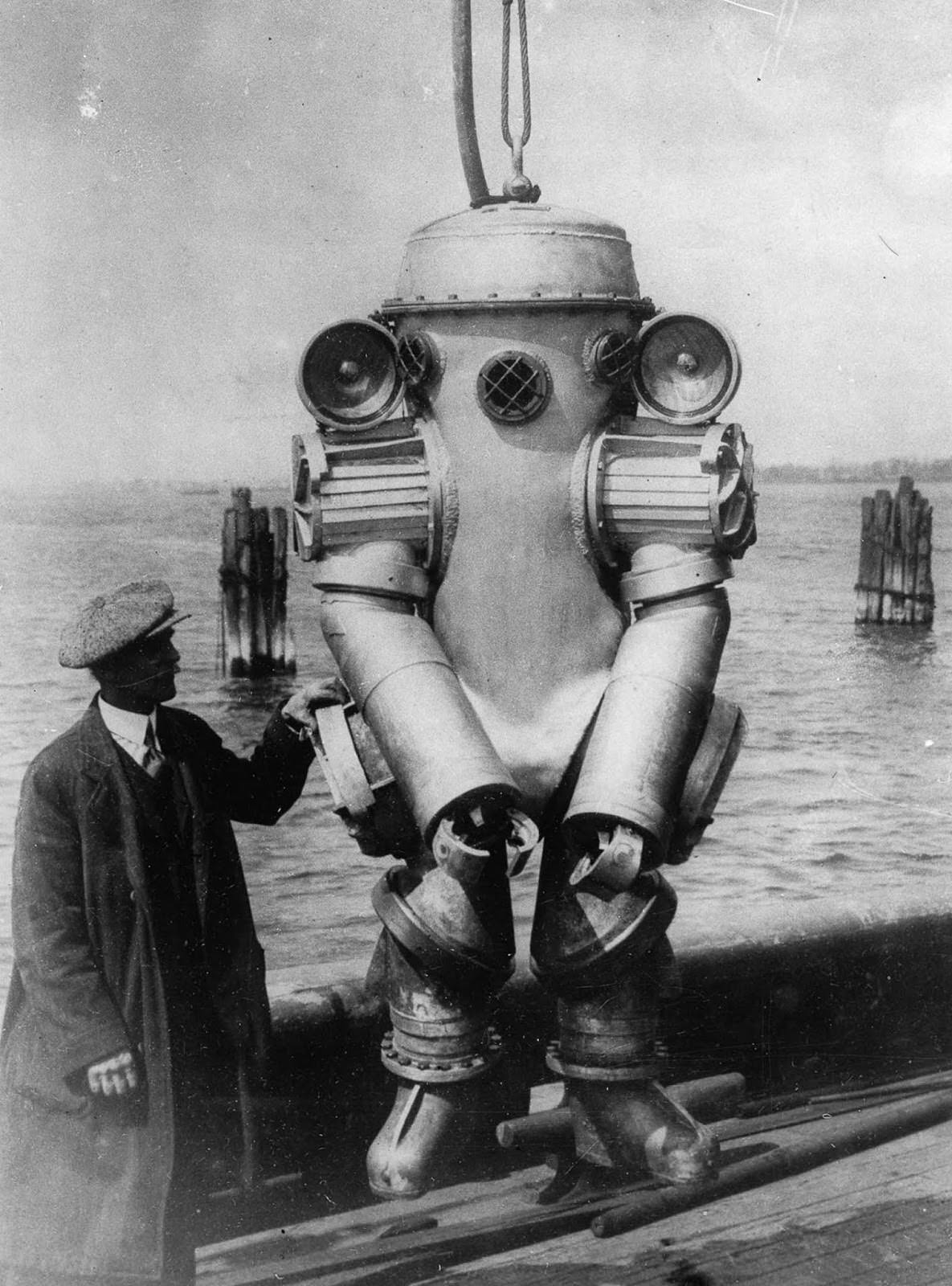
Standing beside a hulking, metal-bodied deep-sea diving suit, American inventor H.L. Bowdoin appears dwarfed by the very technology he helped bring to life. The figure of the suit is all rivets and rounded plating, with thick articulated arms and heavy boots that speak to the engineering challenge of surviving depth and pressure. Behind them, open water and weathered pilings hint at a working waterfront where such experiments belonged.
What draws the eye immediately are the shoulder-mounted 1,000-watt lamps, set like twin searchlights to cut through underwater darkness. A circular faceplate with a small, guarded viewport suggests the diver’s world would be narrow and hard-won, illuminated by brute-force electricity and careful design. The title’s note about an integrated telephone adds a striking modernity—communication built into the suit, not shouted across a deck or reduced to hand signals below the surface.
Placed in 1931, Bowdoin’s invention sits at the intersection of industrial ambition and the era’s fascination with pushing into extreme environments. This historical photo is more than a portrait of a man and his machine; it’s a snapshot of early deep-sea diving innovation, when lighting, mobility, and voice contact were being engineered into a single armored shell. For readers exploring vintage inventions, maritime history, or the evolution of diving equipment, the image offers a vivid reminder of how bold—and bulky—progress could look.