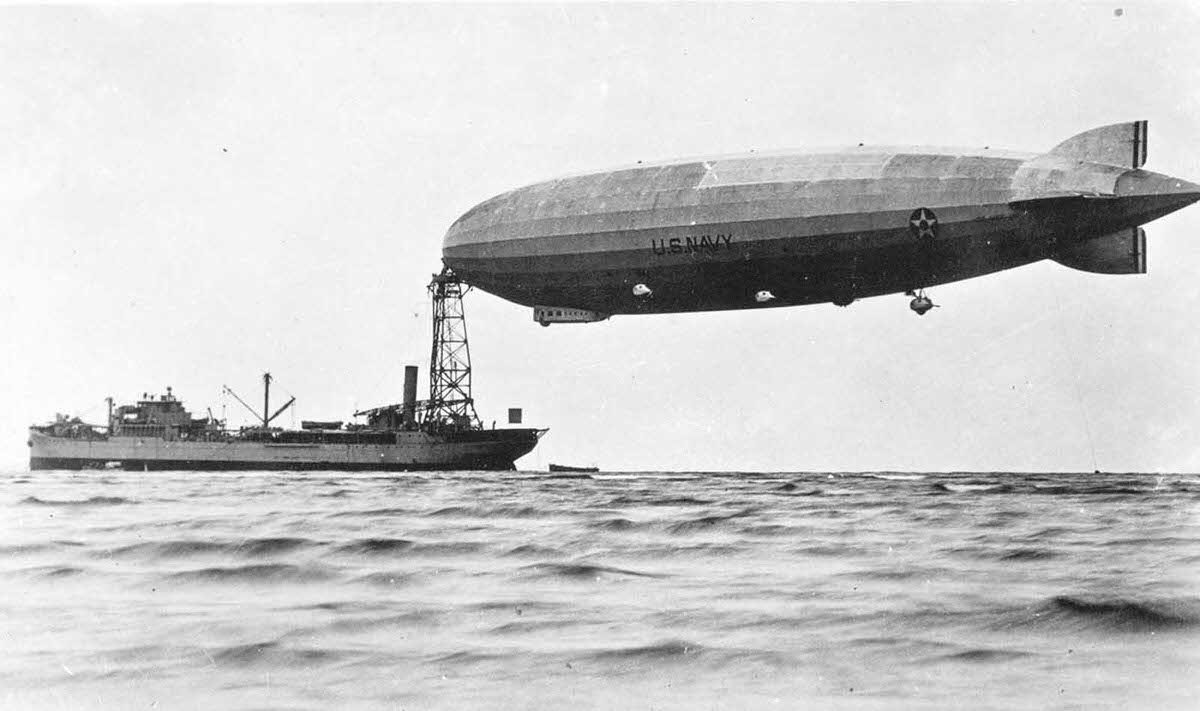
Rising above a low, rolling sea, the airship USS Los Angeles hangs alongside the USS Patoka, its broad hull marked “U.S. NAVY” and a star insignia that helps date the technology and the era without pinning it to a single moment. The composition emphasizes scale: a lighter-than-air giant poised over a comparatively compact ship, with the horizon line kept deliberately low so the sky feels expansive and unclaimed.
On the Patoka, a tall mooring mast and rigging turn the deck into a floating harbor, suggesting the careful choreography required to bring a dirigible safely to rest. Details like the airship’s fins, gondola, and shaded underbelly hint at the engineering compromises of the day—lift versus drag, stability versus payload—while the ship’s utilitarian silhouette speaks to support roles that rarely get the spotlight in aviation history.
For readers exploring naval aviation, early airship operations, or “inventions” that bridged sea and sky, this historical photo captures a practical partnership: a moored dirigible relying on a purpose-built tender to extend its reach. It’s an evocative reminder that innovation often arrives as a system, not a single machine—an airship, a mast, a crew, and a calm patch of ocean working together to make the impossible routine.