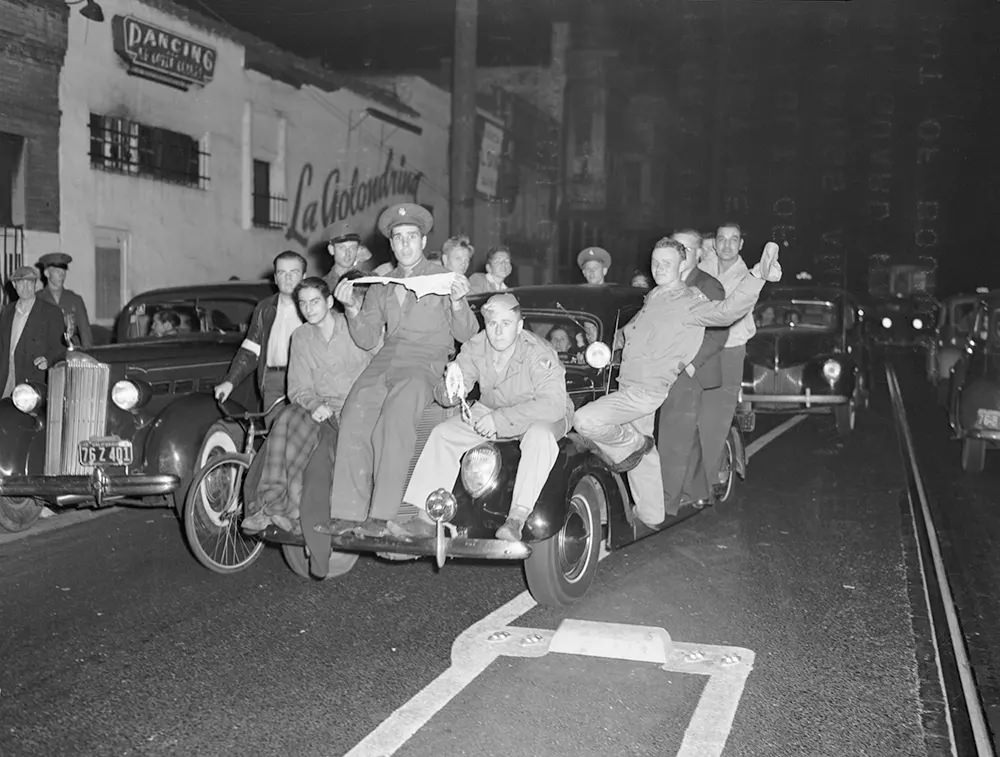
A crowded nighttime street becomes a stage for swagger and spectacle as uniformed servicemen and other onlookers pile onto the hood and running boards of a parked car. Faces turn toward the camera with grins and raised arms, the mood reading like a victory lap—part parade, part dare—while other vehicles and pedestrians press in around them. In the background, signage for dancing and a large painted wall advertisement hint at a nightlife district where music, fashion, and tension could mingle after dark.
The title’s reference to June 9, 1943 points to the Zoot Suit Riots era, when the zoot suit was treated by many newspapers as evidence of delinquency instead of a bold expression of youth culture. Sensational headlines and moral panic helped frame street violence as “cleanup” or “patriotism,” a narrative that blurred accountability and amplified racial targeting. Seen through that lens, the celebratory posing in the street takes on a harsher edge: public bravado unfolding in a climate where media coverage could legitimize intimidation.
Details in the photo—wartime uniforms, tightly packed automobiles, and the informal takeover of public space—underscore how quickly a city can swing from entertainment to unrest. It’s an arresting snapshot of 1940s American urban life, capturing not only the look of the moment but the way crowds perform for themselves and for the press. For readers searching Zoot Suit Riots history, 1943 newspaper influence, or wartime racism and moral outrage, the image serves as a stark reminder that photographs record more than events; they record the stories a society is eager to tell about them.