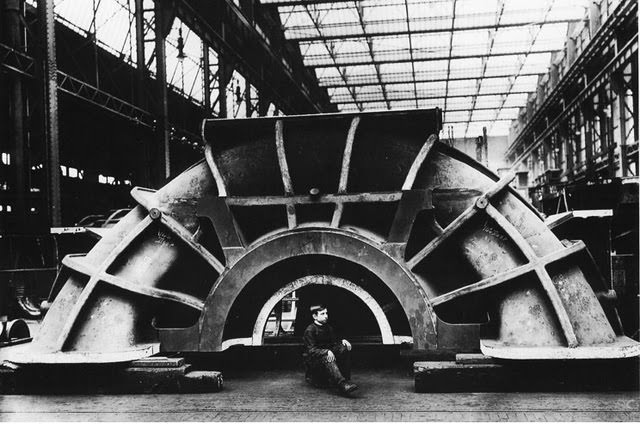
Inside a vast industrial workshop, a towering curved steel assembly dominates the floor, its ribs and bracing forming a monumental arc beneath a high, trussed roof. A lone worker sits at the base, dwarfed by the scale of the metalwork, giving an immediate sense of how shipbuilding relied on both human skill and gargantuan engineering. The composition draws the eye through the central opening, like a gateway into the inner skeleton of a liner being brought to life.
“Building the Unsinkable” invites readers to look past the legend and into the practical world that made the Titanic possible: the design choices, heavy fabrication, and workshop innovations that pushed maritime construction forward. The photo’s stark contrasts emphasize riveted plates, curved frames, and the disciplined geometry that underpinned modern ocean travel. It’s a reminder that the ship’s rise to fame was born not only from luxury and publicity, but also from breakthroughs in industrial methods and the confidence they inspired.
For anyone searching for Titanic construction history, early 20th-century shipbuilding, or the inventions behind great ocean liners, this post sets the stage with a striking glimpse of the era’s manufacturing power. The anonymous figure near the steelwork hints at the countless hands involved—fitters, riveters, machinists—whose labor rarely enters the spotlight. Long before the maiden voyage became a worldwide story, the Titanic’s narrative began in spaces like this, where ambitious ideas were measured in iron, sweat, and scale.