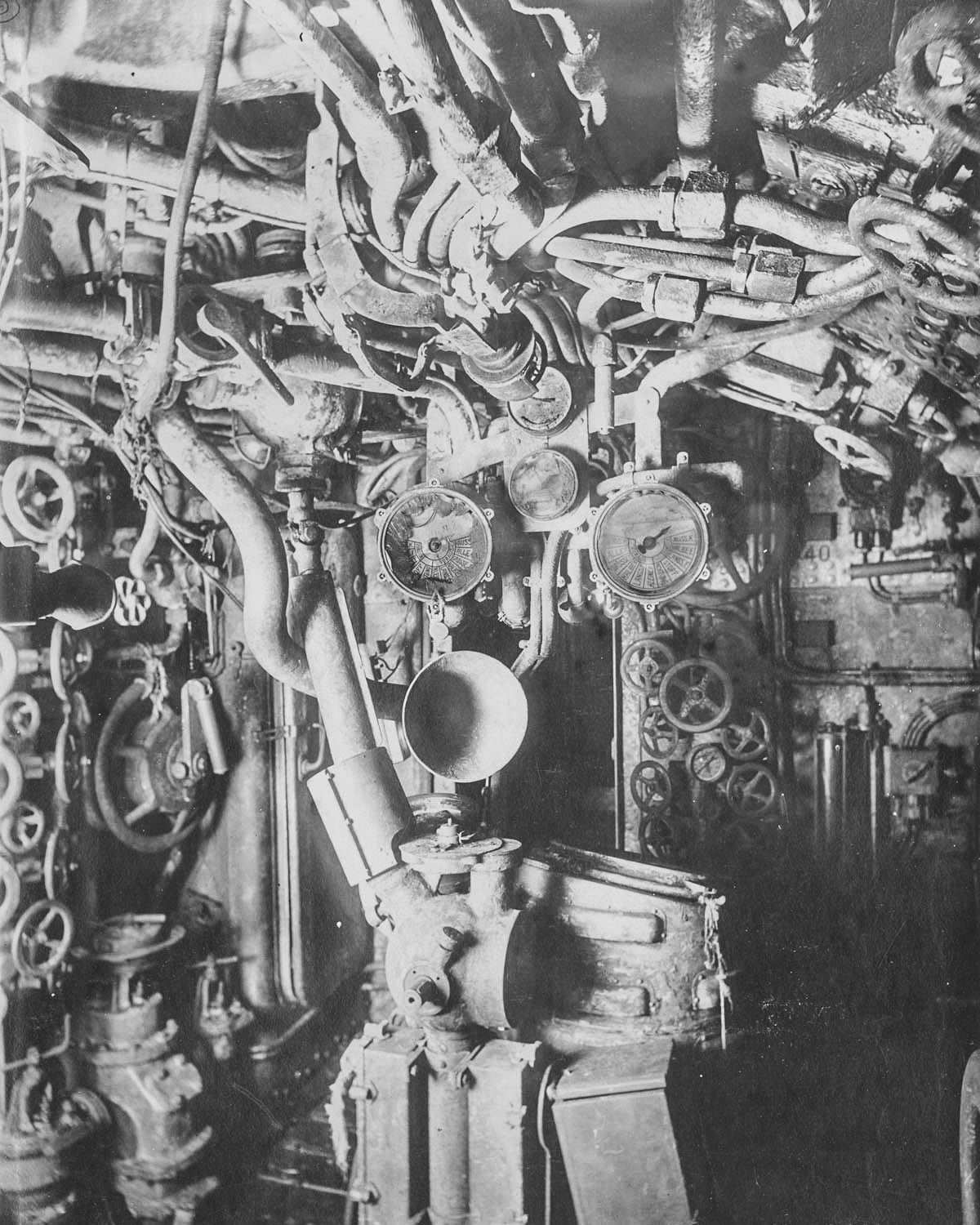
Deep inside a ship’s control room, the frame crowds in on a tangle of pipes, rods, and valves where navigation and propulsion were translated into metal-and-oil reality. The gyro compass sits among the instruments like a steady reference point, while the steering control shaft and surrounding mechanisms hint at the constant, physical labor of keeping a vessel on course. Even without a wide view of the bridge, the density of engineering here suggests how much of seafaring depended on carefully coordinated systems hidden from passengers’ eyes.
Engine telegraphs and voice pipes—devices built for fast, unmistakable communication—anchor the scene in an era when information traveled by pointers, bells, and shouted messages carried through tubes. Gauges and dials cluster nearby, each one a small promise that pressure, direction, and response could be read at a glance. The worn surfaces and utilitarian fittings speak to routine use, the kind that turns precision instruments into familiar tools during long watches.
For readers interested in inventions and maritime technology, this historical photo offers a close-up lesson in early control and command interfaces. Before screens and automation took over, a ship’s “user experience” was a language of levers, mechanical linkages, and audible signals designed to prevent ambiguity under stress. Seen together, the gyro compass, steering apparatus, engine telegraphs, and voice pipes form a portrait of industrial-age navigation—practical, redundant, and built to be trusted at sea.