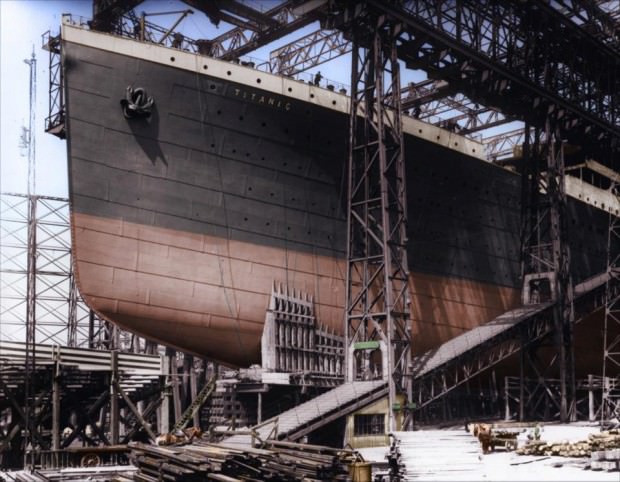
Towering over the shipyard scaffolding, the Titanic’s immense hull dominates the frame, its dark plates and neat rows of rivets emphasizing the sheer scale of the build. The ship’s name is visible along the upper bow, a reminder that this was not just another vessel in progress but a project meant to symbolize modern confidence. Around it, cranes, girders, and temporary platforms form a dense industrial lattice—evidence of the complex choreography required to assemble a liner of unprecedented size.
Industrial ambition is written into every surface here: the smooth curve of the bow, the heavy anchor gear, and the vast expanse of steel waiting to be fitted out. In photos like this, the story of Titanic construction becomes tangible, showing how thousands of components and countless labor hours were coordinated in an era before digital design tools. The shipyard setting also hints at the “inventions” behind the legend—systems, methods, and engineering practices that pushed the limits of early twentieth-century maritime technology.
Long before the famous maiden voyage entered popular memory, the rise to fame began in places like this, where ingenuity met spectacle and progress had a physical, steel-and-rivets presence. The unfinished hull invites readers to look past later tragedy and consider the world that built Titanic: a culture captivated by speed, luxury, and the promise of safety at sea. For anyone exploring Titanic history, shipbuilding innovation, and the mythology of the “unsinkable” liner, this construction scene offers an arresting starting point.