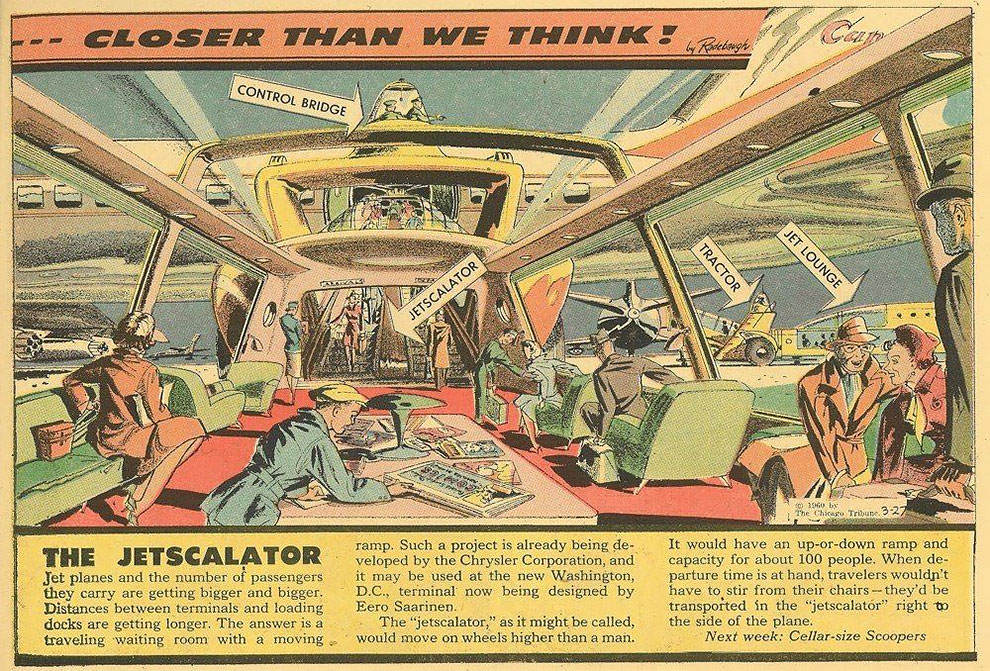
Few ideas sum up mid‑century optimism quite like “The Jetscalator,” a delightfully earnest vision of air travel where the waiting room rolls right up to the airplane. In the illustration, big windows frame a bustling apron while passengers lounge in armchairs, read newspapers, and chat as if they’re in a living room—only this living room is in motion. Above it all, the bold promise “Closer Than We Think!” sells the dream that tomorrow’s airport would feel effortless, fast, and oddly comfortable.
At the center, the so‑called jetscalator forms a corridor between terminal and aircraft, with labels pointing out a “control bridge,” a “tractor,” and even a “jet lounge,” turning the scene into a guided tour of a futuristic system. The concept imagines an elevated, wheeled ramp that carries people without making them stand in lines or trudge across the tarmac, hinting at crowd management and convenience long before today’s jet bridges became standard. It’s both practical and theatrical: a mechanized promenade designed to keep travelers seated, calm, and entertained as departure approaches.
What makes this historical image memorable isn’t just the technology fantasy—it’s the period’s confidence that engineering could smooth every rough edge of modern life. The title’s comic bite fits perfectly, because the proposal is half sensible, half showpiece, like a World’s Fair attraction repurposed for airports. Whether read as aviation history, retro futurism, or simply a funny snapshot of yesterday’s “next big thing,” The Jetscalator captures the moment when the future was always just one more clever machine away.