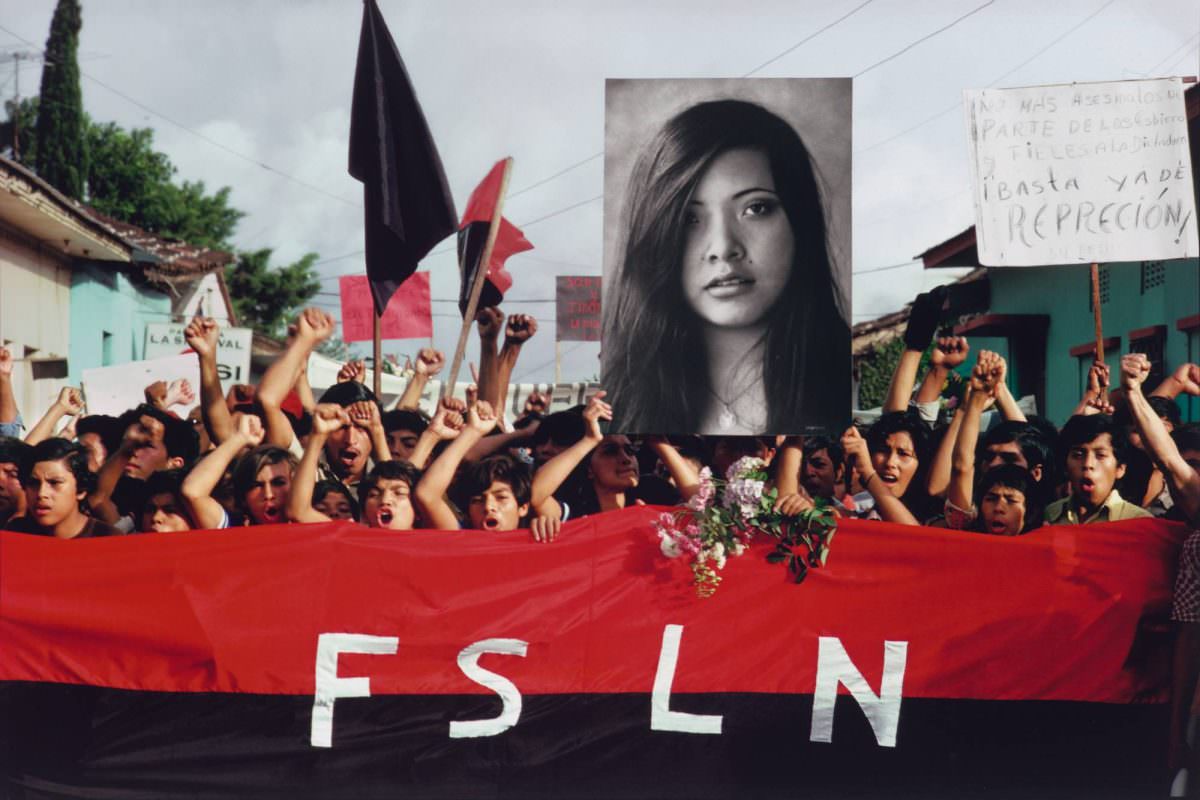
A wave of raised fists surges through the street as mourners and demonstrators move together under the humid light of Jinotepe, their voices implied in open mouths and tightened faces. At the front, a wide red-and-black banner marked “FSLN” stretches like a moving wall, turning the procession into a public statement as much as a farewell. Above the crowd, flags and hand-painted placards punctuate the sky, making grief visible as collective action.
Centered over the march is a large, black-and-white portrait of a young woman, held high so her gaze rides above the people below. Flowers tucked near the banner add a fragile softness amid the hard geometry of protest, while the surrounding bodies press forward in dense solidarity. Meiselas’s color palette—bright reds, deep blacks, sunlit skin tones—heightens the sense that history here is not distant, but immediate and lived.
Susan Meiselas’s 1978 photograph, titled “A Funeral Procession in Jinotepe for Assassinated Student Leaders,” reads as both documentation and memorial, blending political symbols with intimate loss. The Spanish-language signs in the background, calling out repression, anchor the scene in a charged public conversation without needing additional explanation. For readers searching for Susan Meiselas, Jinotepe, 1978, or the visual history of Nicaragua’s unrest, this image remains a powerful example of how a funeral procession can become a rallying point—and how a single carried portrait can stand in for many silenced voices.