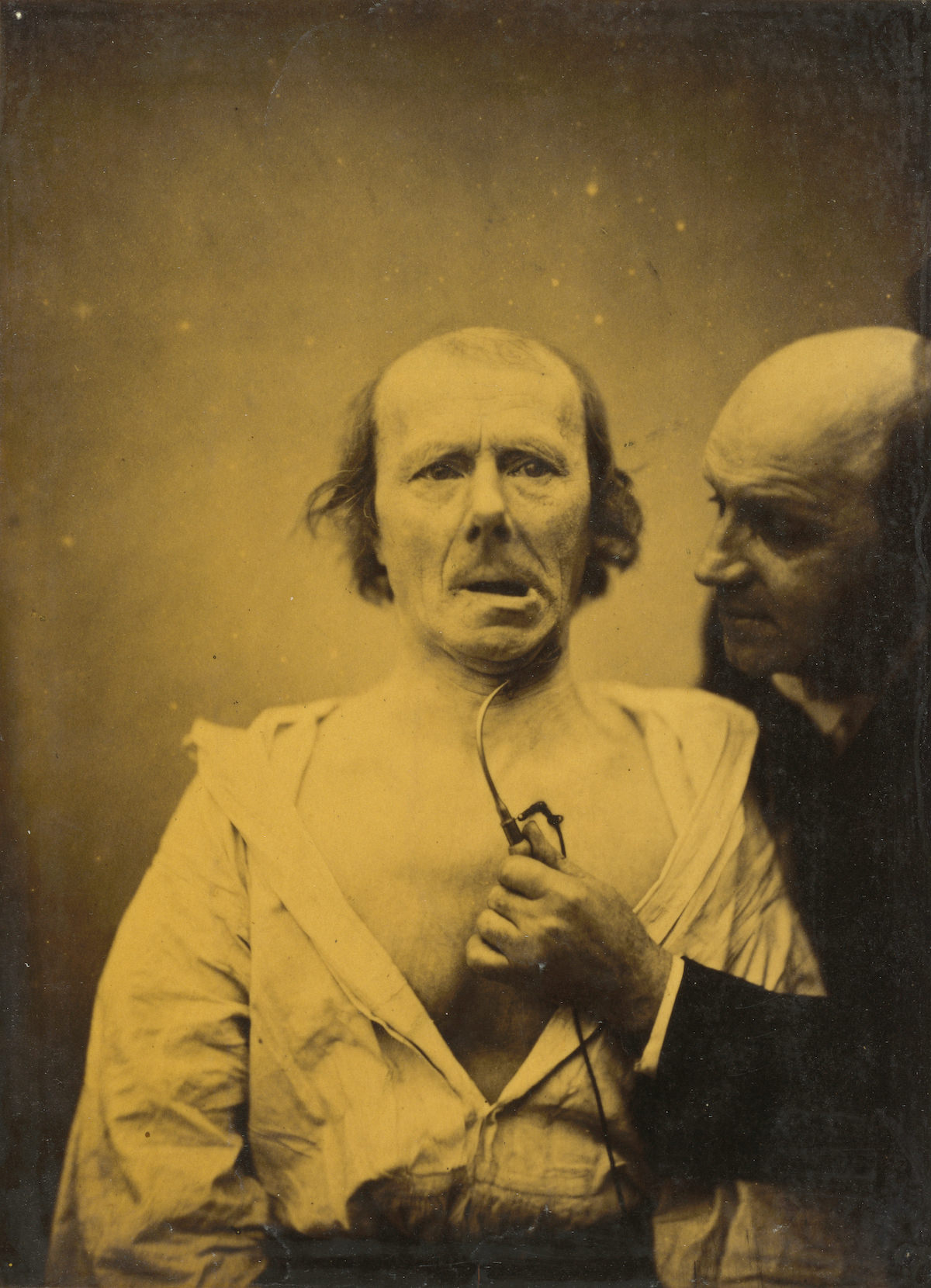
A tense, clinical intimacy hangs in this portrait: a shirt is pulled open to expose the chest while an assistant leans in from the side, guiding a thin wire-like instrument that draws the viewer’s eye back to the subject’s face. The man’s mouth sits slightly ajar, his gaze fixed forward, and the smooth backdrop keeps attention on small muscular shifts—neck, jawline, and the tightness around the lips—that signal discomfort more than drama. Sepia tones and soft focus give the scene the look of an early photographic plate, where stillness was both a technical necessity and a psychological test.
The title, “This contraction of m. platysma alone lacks expression’,” frames the photograph as something closer to anatomical demonstration than ordinary portraiture. It points to the platysma, the broad superficial muscle of the neck, and invites a reading of the face as a map of isolated actions rather than a whole emotion. Here, the strained neck and drawn mouth suggest that what is being sought is not personality, but evidence—how a single muscular contraction can be recorded, compared, and discussed.
Seen today, the image sits at the crossroads of medical history, art, and the early science of expression, when photographers and observers used the camera to freeze fleeting movements for study. The careful staging, the assistant’s proximity, and the stark exposure of the torso underline the period’s confidence in documentation, even when the human subject appears uneasy. For readers interested in historical photography, anatomy, and the visual culture of medicine, this post offers a compelling example of how the body was turned into a text to be read.