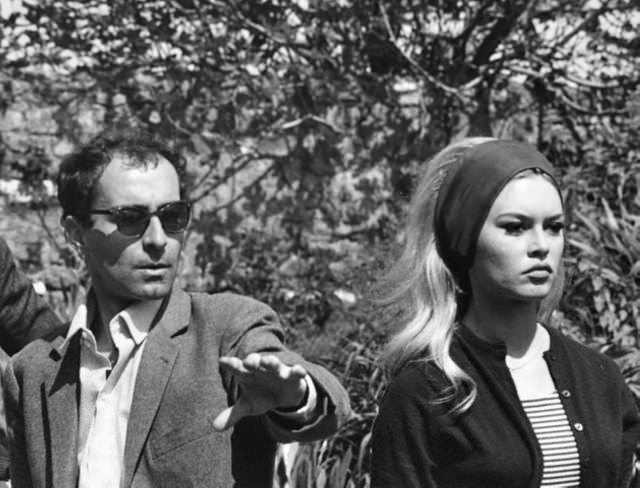
Godard stands in dark sunglasses with an outstretched hand, mid-gesture, while Brigitte Bardot turns away in a headband and cardigan, her expression set and unreadable. Shot outdoors amid tangled branches and bright daylight, the still has the offhand immediacy of a set photograph—part instruction, part performance, part private weather. Even without motion, the tension between director and star seems to hang in the air, as if the scene’s emotional temperature is being negotiated in real time.
Le Mépris (1963) has long been read as both a love story and a meditation on filmmaking itself, and the composition here quietly supports that double vision. His directive posture suggests the machinery of cinema—blocking, framing, control—while her distant gaze carries the stubborn autonomy of a character who refuses easy explanation. For readers searching Godard’s French New Wave, Bardot’s screen presence, or the anatomy of artistic collaboration, this image offers a compact lesson in how a film can stage desire and disillusionment at once.
Behind Bardot’s gaze sits the larger question the movie keeps asking: what happens when intimacy is filtered through work, money, and performance? The photo invites a closer look at gesture and body language, at who speaks and who withholds, at how contempt can be communicated without a single line of dialogue. As a historical snapshot from the era of auteur cinema, it makes a fitting entry point for exploring Le Mépris, its on-set dynamics, and its enduring place in classic film history and Movies & TV culture.