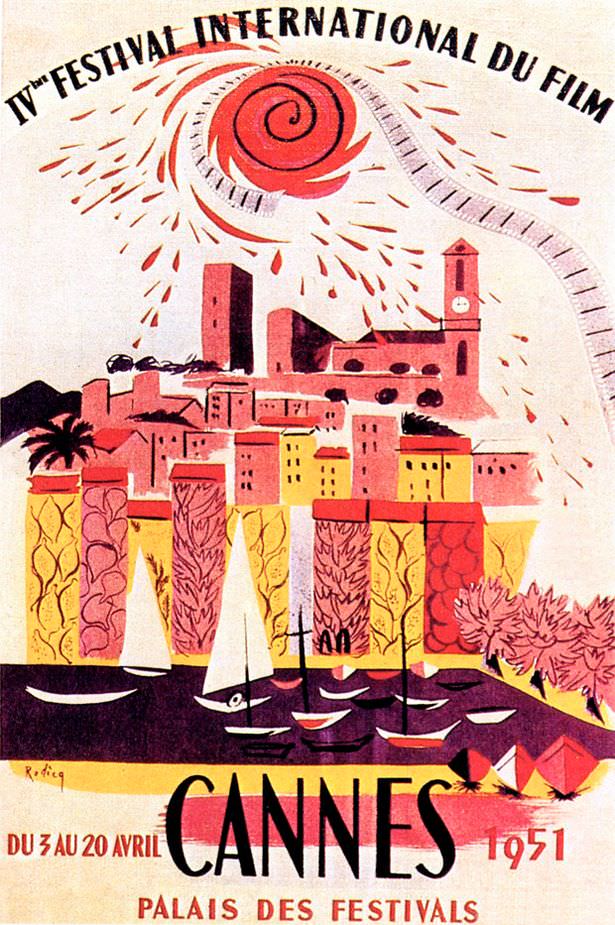
Bright blocks of Mediterranean colour stack up like stage scenery on the cover art for the “IVe Festival International du Film,” with a ribbon of film curling into a fiery spiral overhead. Below, a simplified skyline—towers, a church-like façade, and clustered buildings—rises above dark water where small sailboats bob in silhouette, anchoring the design in seaside glamour. The poster’s playful, modernist shapes and limited palette make it feel both celebratory and slightly surreal, as if cinema itself has become weather, showering the town with light.
After the festival’s 1950 hiatus, the title’s story of a return in 1951 reads right out of the artwork: movement is everywhere, from the sweeping filmstrip to the rhythmic patterns on the waterfront structures. The typography reinforces the sense of occasion—CANNES boldly stamped at the bottom, with “1951” and “Palais des Festivals” calling out the event’s renewed home in a dedicated venue. Even without a single celebrity in view, the poster sells the idea of Cannes as a meeting point of art, architecture, and the sea.
For anyone browsing film history, Cannes Film Festival memorabilia, or mid-century graphic design, this cover art is a compact time capsule of post-war optimism and cultural ambition. It’s also a reminder that festivals can be temperamental institutions: sometimes pausing, sometimes reinventing, then roaring back with a new stage and a fresh visual identity. Here, Cannes announces its comeback not with realism, but with symbolism—boats, sun, and celluloid woven into one bold invitation.