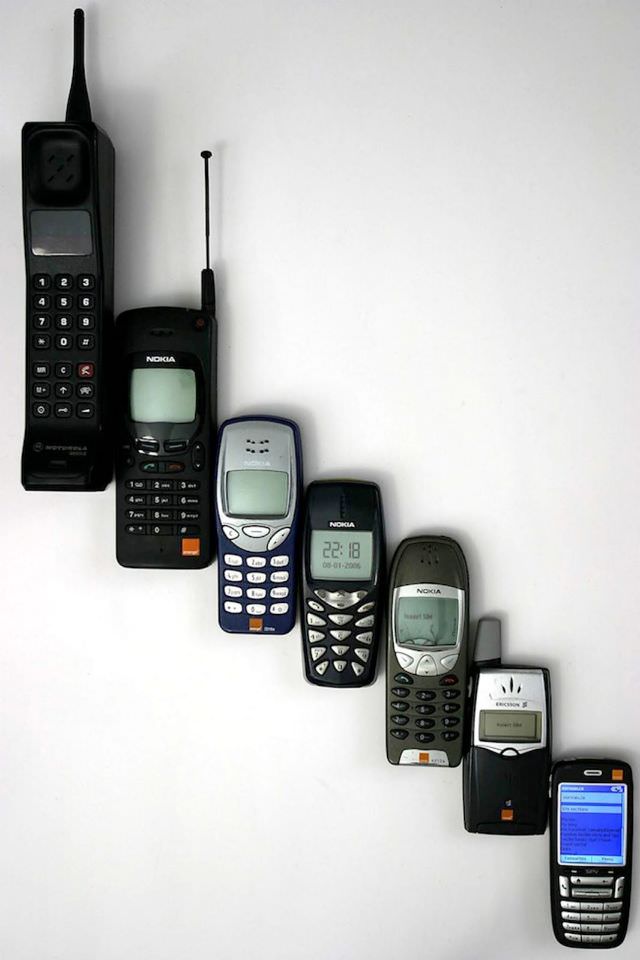
Lined up like stepping-stones across a blank background, these handsets trace the rapid redesign of the mobile phone during the 1990–2000 decade. At one end sits the bulky “brick” style with a long external antenna and a no-nonsense keypad; further along, bodies shrink, corners soften, and screens become clearer and more legible. Even without a visible brand timeline, the progression speaks to a moment when portability started to matter as much as simply making a call.
Design changes in this era weren’t just cosmetic—they were tied to how people actually used their phones day to day. Physical buttons dominate every model here, from tall numeric pads built for dialing to later layouts that hint at faster texting and menu navigation. Small monochrome displays, sturdy casings, and replaceable battery culture shaped a generation of devices that had to survive pockets, briefcases, and long commutes while staying connected to expanding cellular networks.
By the end of the lineup, the silhouette is notably more compact and the screen begins to feel like the main event, foreshadowing the shift toward data features and early mobile internet. For readers interested in the evolution of mobile phones from 1990 to 2000, this photo offers an immediate visual summary of how quickly manufacturers iterated—compressing size, refining ergonomics, and turning a status-heavy gadget into an everyday tool. It’s a small museum of inventions that paved the way for the smartphone age that followed.