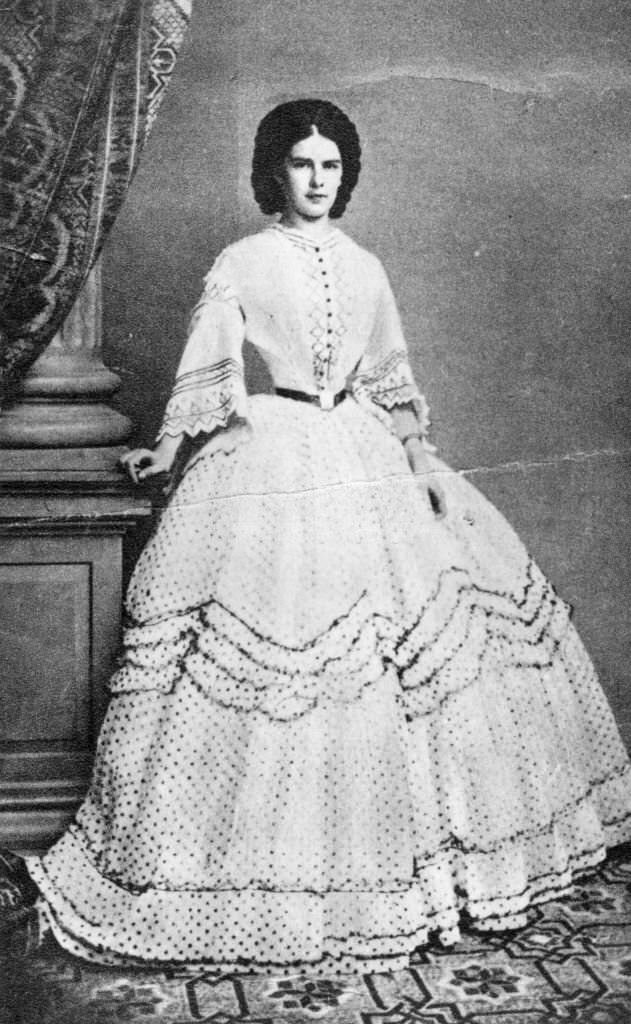
Poised beside a studio plinth and heavy drapery, Empress of Austria Elisabeth Amalie Eugenie (1837–1898) faces the camera with a calm, direct gaze that suits the formality of mid-19th-century portraiture. Her dark hair is parted and arranged in smooth, voluminous coils, framing a youthful face set against a plain backdrop. The careful staging—architectural column, patterned curtain, and carpeted floor—signals rank while keeping attention on silhouette and dress.
Dominating the composition is the unmistakable breadth of the crinoline, the cage-supported skirt that became an icon of 1850s fashion and court display. The gown’s fitted bodice closes down the front with neat buttons, cinched by a narrow belt that emphasizes a small waist before the skirt blooms outward. Light fabric dotted with small motifs and finished with tiers of ruffles and trim creates a play of texture across the sweeping circumference, while wide sleeves with decorative bands add balance to the overall shape.
Beyond its elegance, the portrait offers a vivid document of fashion and culture in the era when photography began to fix royal imagery in the public imagination. Crinoline dress was more than ornament: it projected modernity, wealth, and a disciplined ideal of femininity, even as it required space and careful movement. For historians and costume enthusiasts alike, this 1854 view of Empress Elisabeth stands as a searchable touchstone for Austrian imperial style, 19th-century women’s dress, and the visual language of status in early photographic studios.