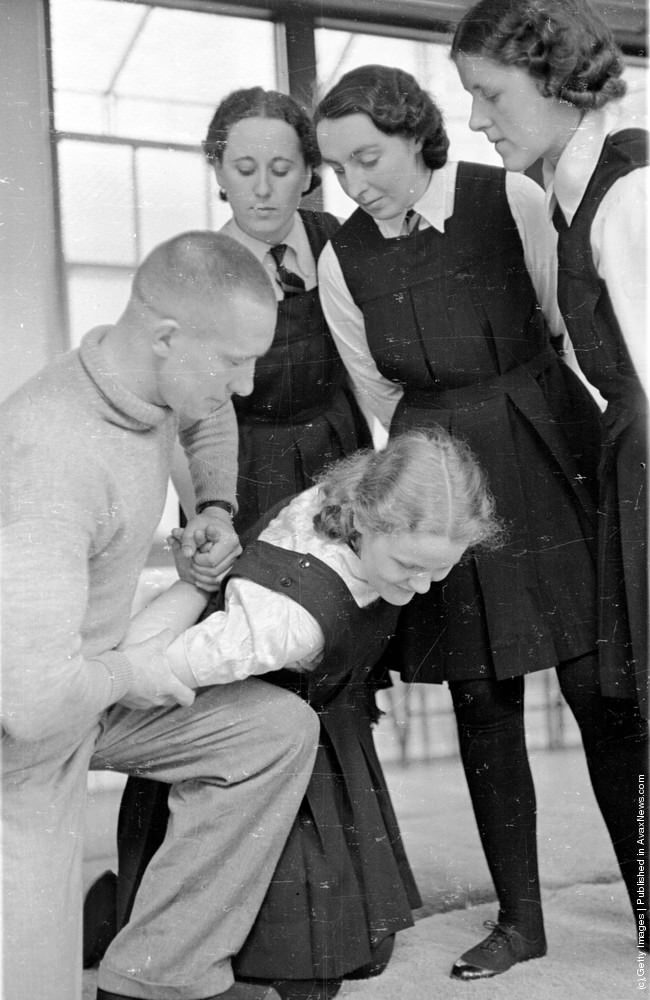
In a bright training hall, trainee policewomen lean in with focused expressions as a ju-jitsu instructor demonstrates a firm wrist-and-arm hold. One recruit is guided into the technique, her posture folded forward as she learns how leverage can control a stronger opponent. The uniforms—dark pinafore-style dresses over crisp blouses—add a striking contrast to the practical, hands-on lesson unfolding in the foreground.
Taken in 1939, the scene speaks to an era when women in policing were being prepared for more than clerical duties, with self-defence and restraint methods becoming part of professional instruction. Ju-jitsu, long valued for its emphasis on balance and technique, offered a way to subdue without relying on brute force—an approach well suited to the demands of public order and personal safety. The trainees’ attentive stance suggests a classroom atmosphere where observation, repetition, and discipline mattered as much as physical strength.
Details like the large windows, the plain floor, and the close clustering of onlookers give the photograph an immediacy that modern viewers can feel. For readers searching for “women police training 1939” or “ju-jitsu lessons for policewomen,” this image provides a vivid glimpse into early self-defence education and the evolving role of women in law enforcement. It’s a reminder that policing history is also a story of training rooms, quiet concentration, and skills learned one careful grip at a time.