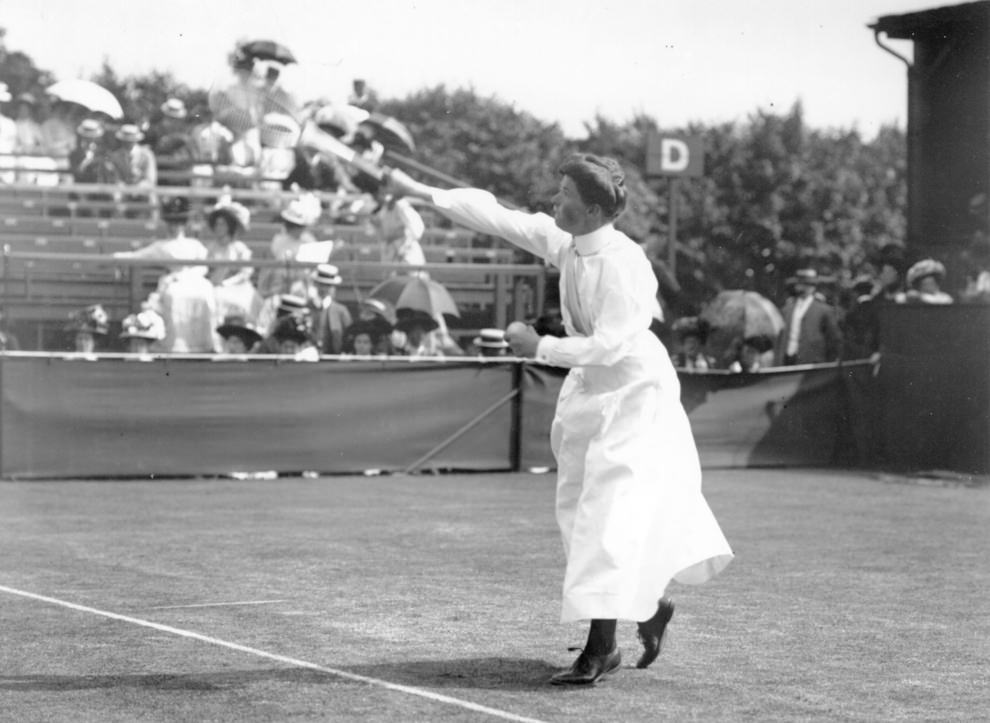
Charlotte Sterry is caught mid-stroke on the Wimbledon grass in 1908, her racket arm extended and her weight shifting forward as if the ball has only just left the strings. The long, bright playing dress and sturdy footwear speak to an era when women’s tennis demanded adaptation and grit, balancing athletic movement with the expectations of formal attire. Behind her, spectators fill the stands, some shaded by umbrellas, turning the match into a social occasion as much as a sporting contest.
Crowd details give the scene its texture: hats, summer clothing, and a packed terrace create a backdrop of quiet attention while Sterry occupies the open court with purposeful focus. The low barrier and the clearly marked lines emphasize how close viewers were to the action, and the shallow depth of field keeps the eye on her poised form. Even without sound, the photograph suggests the rhythms of early lawn tennis—measured footwork, controlled swings, and the soft drama of points won on grass.
Her record as a multiple Wimbledon Ladies’ Singles champion—spanning 1895, 1896, 1898, 1901, and 1908—adds weight to this moment, placing the image within a remarkable competitive career. For readers exploring Wimbledon history, British tennis heritage, or the evolution of women’s sport, the photo offers a vivid reminder of how champions performed in a very different sporting world. It’s a portrait not only of a player, but of an atmosphere: tradition in the stands, intensity on the baseline, and the enduring appeal of Wimbledon competition.