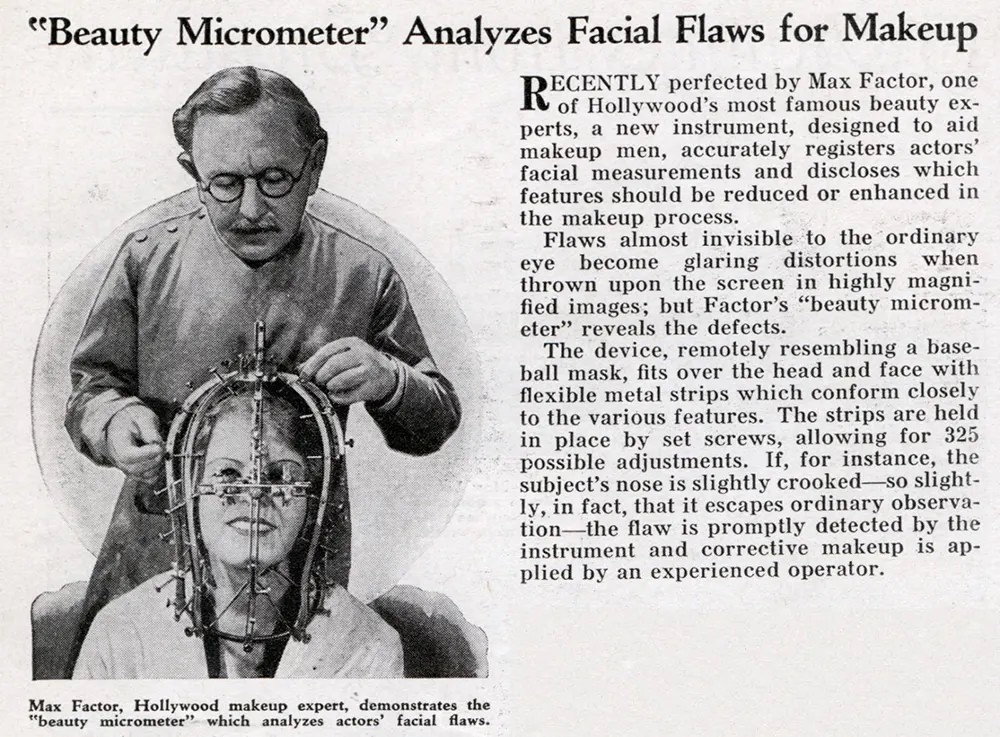
A bespectacled makeup expert leans over a seated woman whose face is framed by an unsettling cage of metal bands, screws, and measuring bars. The apparatus—presented in the accompanying headline as a “Beauty Micrometer”—wraps around the head like a rigid mask, turning the sitter into a kind of living blueprint. Even without motion, the scene feels clinical, as though the human face has been temporarily reassigned from expression to engineering.
To the right, the printed article explains the contraption’s purpose in the language of precision: facial measurements are “accurately” registered so that features can be “reduced or enhanced” through makeup. The text describes flexible metal strips adjusted by set screws and emphasizes how tiny irregularities, invisible in everyday life, become “glaring distortions” under magnification and screen projection. In other words, the device promises to translate beauty into numbers, then use cosmetics as a corrective technology.
Seen through a cultural history lens, this 1930s-era beauty calibrator reflects the growing power of film, studio lighting, and close-up photography to define new standards of facial perfection. It also reveals an early fascination with quantifying appearance—an ancestor to later cosmetic “analysis” tools and today’s algorithmic face filters. The photograph and its promotional copy sit at the crossroads of fashion and culture, where modernity’s faith in measurement meets the anxious pursuit of an idealized, camera-ready face.