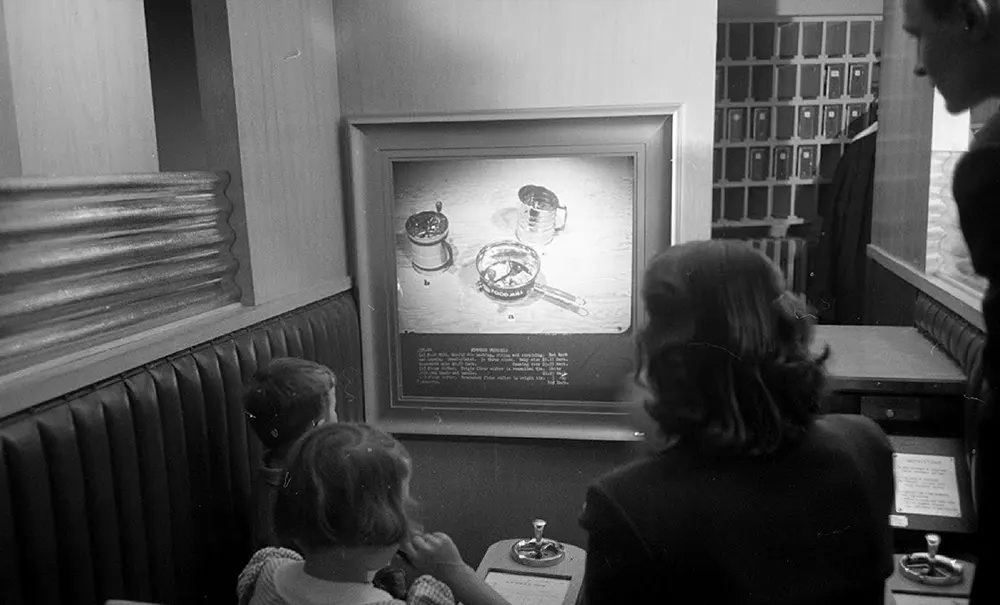
Behind the padded booth walls, a small group gathers around a glowing display that looks part television, part catalog. On the screen, household goods are presented with the tidy clarity of an advertisement, complete with a caption block meant to stand in for the fine print. It’s a scene that feels surprisingly familiar to anyone used to clicking through product photos, yet everything here is physical—an enclosed kiosk, a shared viewing space, and a sense of novelty in simply browsing.
Instead of wandering aisles, customers could select items from the screen, then rely on the company to pack and ship the order afterward—a pre-internet version of online shopping that still required being “on site” to shop. The arrangement suggests an early attempt at merging retail and media: controlled lighting, curated images, and a streamlined menu of products rather than shelves full of stock. Even the posture of the viewers hints at a new kind of consumer behavior, one driven by information and display rather than touch and inspection.
For historians of technology and everyday life, this invention sits neatly in the long story of commerce becoming remote, automated, and image-led. It foreshadows e-commerce, interactive kiosks, and the modern habit of ordering without carrying anything home, while also reminding us how many experiments were needed before shopping became truly digital. If you’re searching for “pre-internet online shopping store,” “early shopping kiosk,” or “interactive catalog screen,” this photo offers a vivid window into the moment retail started to move from counters and carts to screens and shipping boxes.