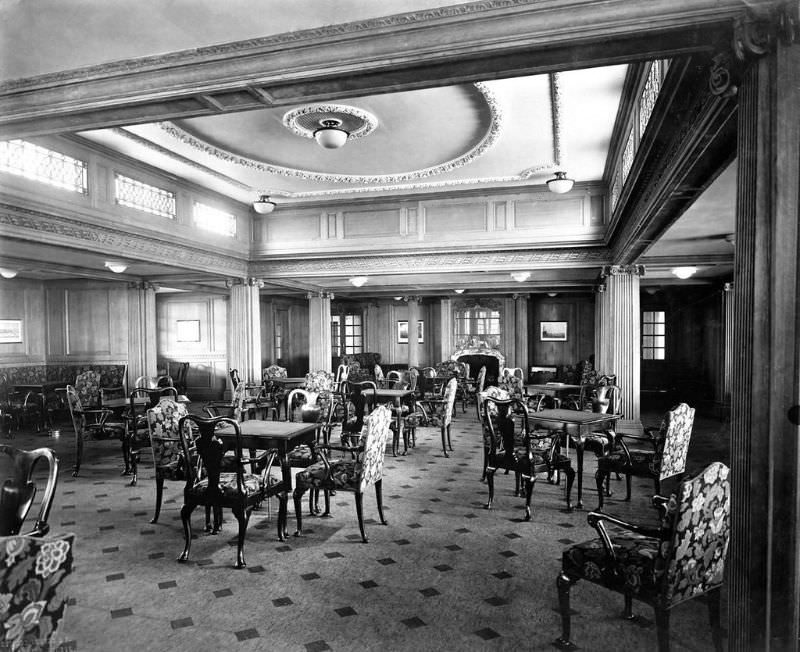
Polished woodwork, a coffered ceiling, and a broad, open floor plan give the 2nd Class Smoking Room aboard Aquitania the feel of a respectable club rather than a mere shipboard lounge. Tables are spaced for conversation and cards, while upholstered chairs with patterned fabric soften the room’s formality and invite travelers to settle in. Even without the bustle of passengers, the scene suggests a carefully managed balance between comfort and order, designed for long hours at sea.
Along the upper walls, frosted or textured glass panels and evenly placed light fixtures hint at the era’s fascination with modern interiors—spaces engineered to be bright, ventilated, and reassuringly stable. The carpet’s repeating geometric pattern anchors the room and subtly guides the eye toward the far end, where doors and partitions frame a sense of depth. Details like the decorative ceiling medallion and sturdy columns speak to the liner’s ambition: second-class amenities that echoed first-class style, scaled for a wider public.
Wander through this photograph and you can almost hear the low murmur of tobacco talk, the scrape of chair legs, and the steady pulse of the ship beneath it all. For anyone researching Aquitania interiors, ocean liner history, or early 20th-century passenger life, the image offers a clear look at how social spaces were staged—equal parts leisure, etiquette, and engineering. It’s a small museum of everyday travel, preserved in wood grain, upholstery, and light.