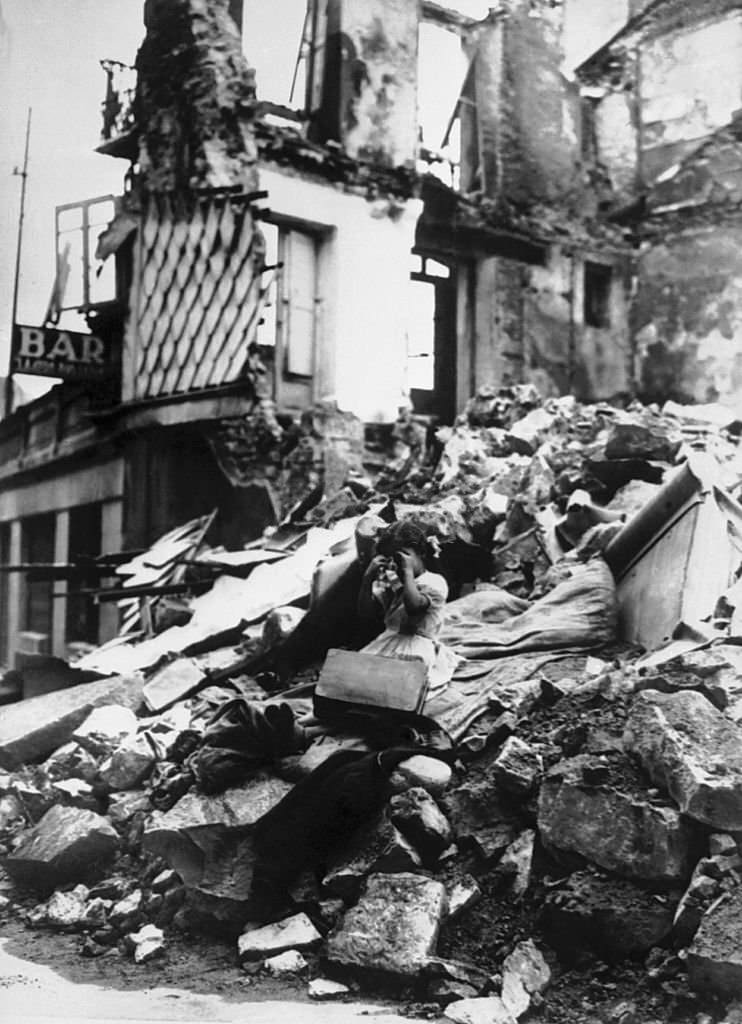
Amid the shattered masonry and splintered beams of Irun, a young girl sits on a slope of rubble, her hands raised to her face as if to hold back the shock. Behind her, the façade of a once-standing building hangs open to the sky, its windows blown out and walls stripped to their frames. A surviving “BAR” sign at the edge of the scene hints at the everyday street life that existed here before the Spanish Civil War turned familiar corners into wreckage.
The photograph’s power lies in its scale: the child appears small against the jagged heap of stones and broken household remnants, a human measure for destruction that statistics can’t convey. Blankets or fabric spill over the debris like hurriedly abandoned belongings, suggesting a home emptied in panic rather than packed for departure. Even without visible soldiers or smoke, the aftermath speaks loudly—this is what modern conflict looks like when it reaches the doorstep.
Seen today, this historical image from the Spanish Civil War reads as both documentary evidence and a quiet indictment of how civil wars fracture communities from the inside out. Irun becomes more than a place name; it becomes a symbol of civilians caught between collapsing buildings and collapsing certainties. For readers searching for Spanish Civil War history, wartime photography, or the civilian experience of urban ruin, this scene offers an unforgettable, wrenching glimpse into a life interrupted.