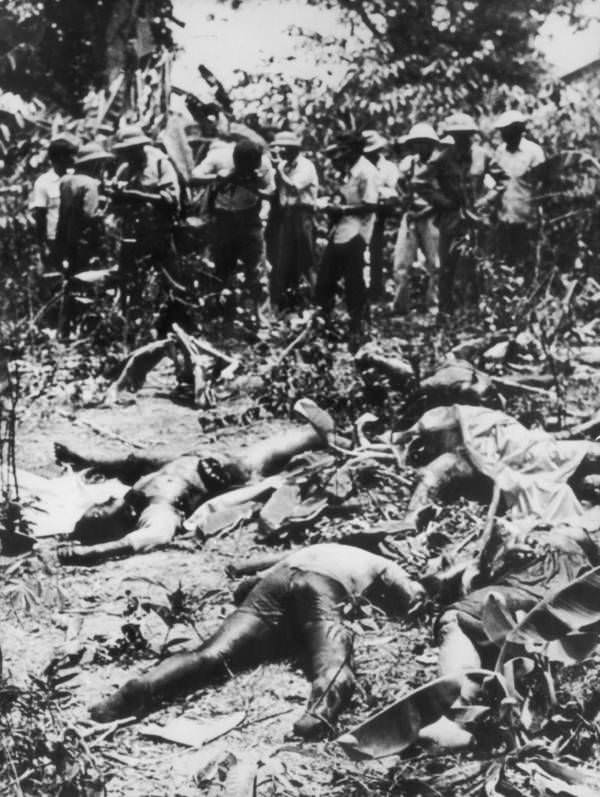
Under a canopy of trees in My Duc, Vietnam, the ground is littered with bodies, turning an ordinary field into a stark record of mass violence. In the background, a cluster of onlookers stands close together, their pale hats and shirts catching the light as they face the devastation at their feet. The contrast between the stillness in the foreground and the tense gathering beyond makes the scene feel both immediate and unbearable.
Photographs like this one sit at the intersection of evidence and memory, especially when discussing the Khmer Rouge era and the wider wars that spilled across borders in the late 1970s. The composition offers few landmarks, which only intensifies the sense of anonymity inflicted on the victims—people reduced to shapes amid leaves, dirt, and discarded clothing. For readers exploring civil wars in Southeast Asia, it underscores how quickly political conflict can collapse into atrocities against civilians.
Seen today, the image forces a confrontation with what “massacre” looks like after the shooting stops: not combat, but aftermath, witnesses, and silence. It also invites careful reflection on documentation itself—why such scenes were recorded, how they were circulated, and what they demand of anyone who encounters them. As a historical photo tied to My Duc and 1978, it remains a sobering entry point into discussions of war crimes, border violence, and the human cost of ideology and power.