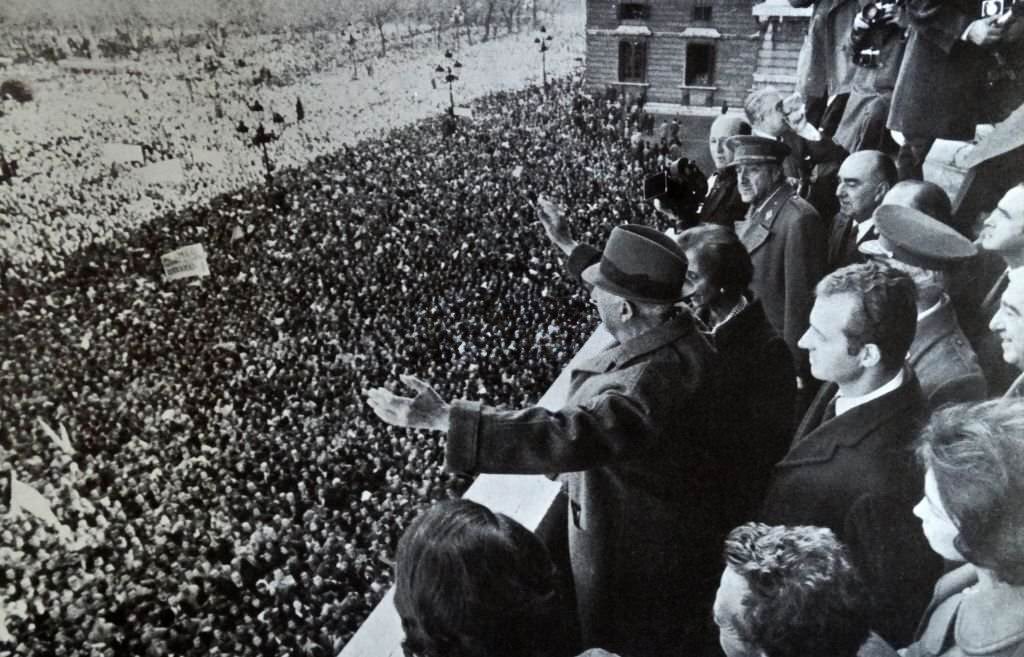
From a packed balcony above an immense sea of faces, Spain’s ruling circle appears in a carefully staged public moment: the Spanish leader stands forward with arms extended, acknowledging a crowd that stretches to the edge of the frame. Beside him are his wife, Carmen Polo, and a young Juan Carlos—later King of Spain—whose presence lends the scene an unmistakable sense of succession and political choreography. The angle emphasizes authority and spectacle at once, with uniforms, coats, and a tight cluster of officials and photographers turning the balcony into a symbolic platform.
The atmosphere below reads like a mass rally, dense enough to feel almost textured, while the figures above remain sharply separated by height and barrier. That physical distance mirrors the era’s political divide, a theme often tied to Spain’s longer legacy of civil conflict and the unresolved tensions that followed it. Captured in 1969, the photograph sits at a pivotal point in late-Franco Spain, when the question of what would come next was no longer abstract but visibly performed in public.
For readers interested in Spanish history, Francoist propaganda, and the transition toward monarchy, this image offers more than a ceremonial greeting—it provides a snapshot of power being displayed and continuity being signaled. Juan Carlos’s proximity to the dictator and Carmen Polo underscores how the regime sought legitimacy through ritual and carefully arranged appearances. As a historical photo, it invites close reading: the crowd’s scale, the officials’ body language, and the balcony’s commanding viewpoint all speak to the politics of spectacle in twentieth-century Spain.