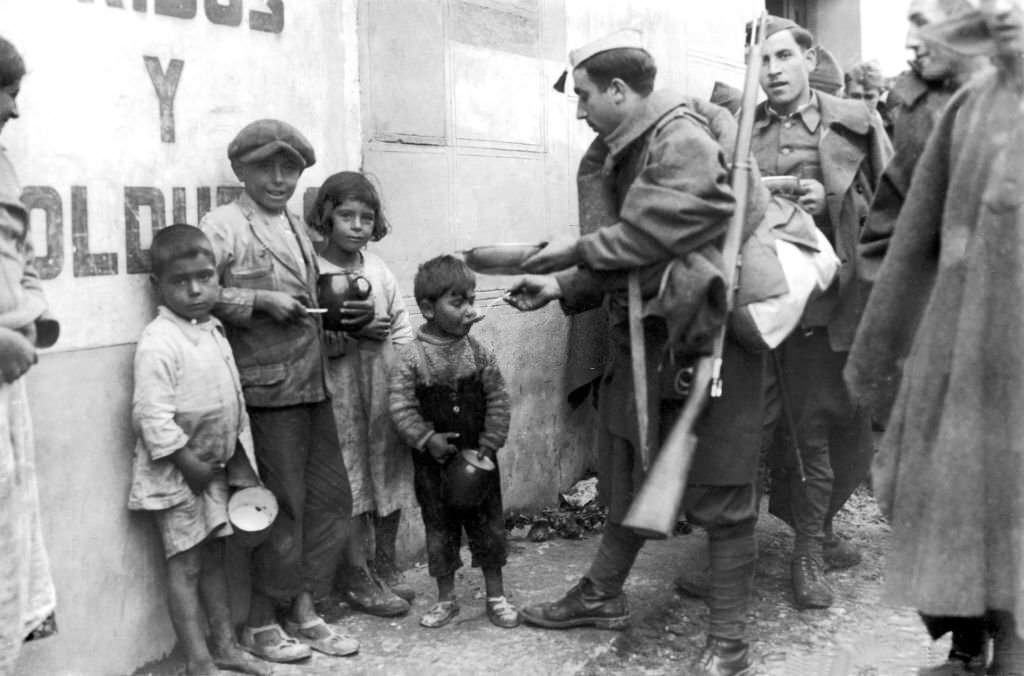
Against a bare wall marked with large painted lettering, a small group of children waits with tins and bowls in hand, their faces set in the wary stillness that often follows hunger. A soldier in uniform leans forward to offer a spoonful from a pot, while another stands close by with a rifle slung over his shoulder, the tools of war sharing the frame with a moment of relief. The contrast is striking: improvised charity under military guard, played out at street level where civilians and combatants meet.
The title places the scene in Madrid in 1936, at the outset of the Spanish Civil War, when the city’s daily life was rapidly reshaped by shortages, displacement, and the constant pressure of conflict. Food provision—whether organized by authorities, units in the field, or local relief efforts—became a visible measure of control and a necessity for survival, especially for children. In photographs like this, a single ladleful of nourishment carries multiple meanings, from urgent humanitarian need to the messaging value of being seen to provide.
Clothing details—the caps, worn jackets, and scuffed shoes—hint at a population already strained, and the children’s careful grip on their containers suggests how precious a ration could be. For readers searching for Spanish Civil War history, Madrid 1936, or wartime rationing, this image offers a grounded glimpse into the lived experience behind headlines and battle maps. It invites reflection on how civil wars compress public life into narrow spaces where aid, authority, and vulnerability stand shoulder to shoulder.