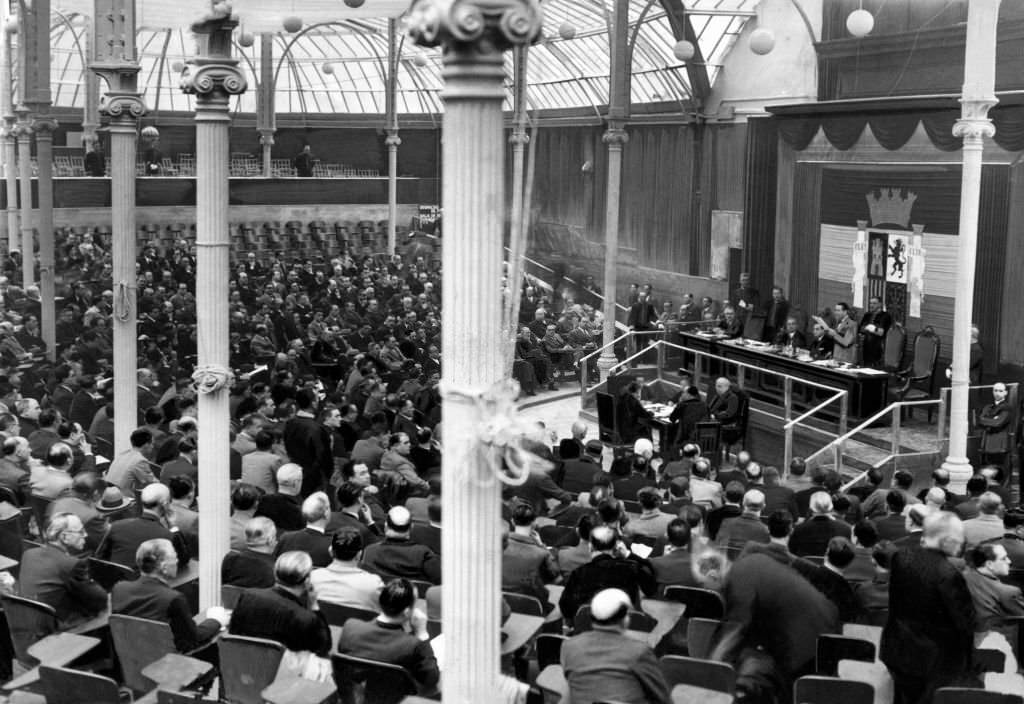
Under the glass-and-iron canopy of Madrid’s Crystal Palace in Parque del Retiro, Parliament gathers in dense rows, turning a public exhibition hall into a charged chamber of state. The photograph’s sweeping perspective emphasizes scale: packed benches, men in dark suits leaning forward, and the ordered geometry of columns framing the proceedings. At the far end, a raised platform and draped backdrop focus attention on the officials presiding over a pivotal vote.
The title anchors the scene to May 10, 1936, when Spanish reformist Prime Minister Manuel Azaña was elected President of the Republic, replacing the conservative Niceto Alcalá-Zamora. Even without close-ups, the image conveys the ritual of legitimacy—formal seating, a central table, and a guarded space before the dais—set against the airy transparency of the Crystal Palace roof. It is a reminder that the institutions of the Second Spanish Republic were performing democracy in a venue built for light, spectacle, and civic modernity.
Seen through the lens of “Civil Wars,” this moment carries an uneasy tension, as debates over authority and reform were hardening across Spain. The crowd’s concentration, the tight clustering around the platform, and the careful staging all suggest how much was believed to be at stake in this parliamentary decision. For readers searching Spanish Civil War context, Second Republic politics, or Manuel Azaña’s rise to the presidency, the photo offers a stark snapshot of governance on the eve of national rupture.