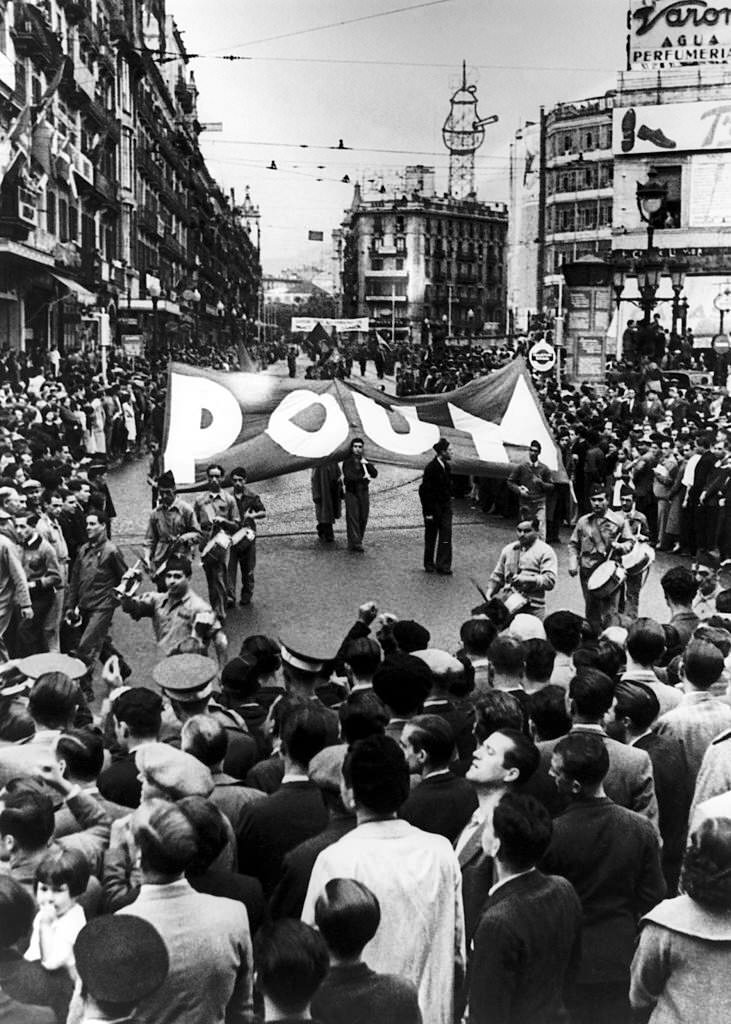
A packed city avenue becomes a stage for remembrance as a vast banner reading “DOU…” is carried through the crowd, its fabric billowing between marchers and onlookers pressed shoulder to shoulder. Uniformed figures and musicians with drums and brass weave along the front, while flags rise above the procession and overhead wires crisscross the sky, anchoring the scene in an urban, modernizing Catalonia. Shopfronts and tall façades line the route, turning everyday streets into a public forum where politics, memory, and spectacle meet.
Marked by the post title as the Anniversary of the Catalonian Revolution, 1936, the photograph hints at how the Spanish Civil War era was lived not only at the front but also in civic rituals—parades, demonstrations, and mass gatherings that asserted allegiance and identity. Faces tilt upward and inward, watching the march pass as if the street itself were a newspaper headline, and the mix of civilian suits with militia-style dress suggests a society mobilized across social boundaries. Even without specific names or precise coordinates, the signage, architecture, and dense turnout evoke Barcelona’s commercial boulevards and the charged atmosphere of wartime Catalonia.
For readers searching Civil Wars history, this image offers an immediate sense of scale: the revolution’s anniversary was not a private commemoration but a collective performance carried by thousands of bodies in close quarters. The partially obscured lettering on the banner invites questions—what full slogan was being proclaimed, which organization sponsored the march, and how did authorities and factions negotiate visibility in public space? Seen today, the photograph serves as a visual entry point into the contested narratives of 1936, when streets became battlegrounds of ideas as surely as any trench.