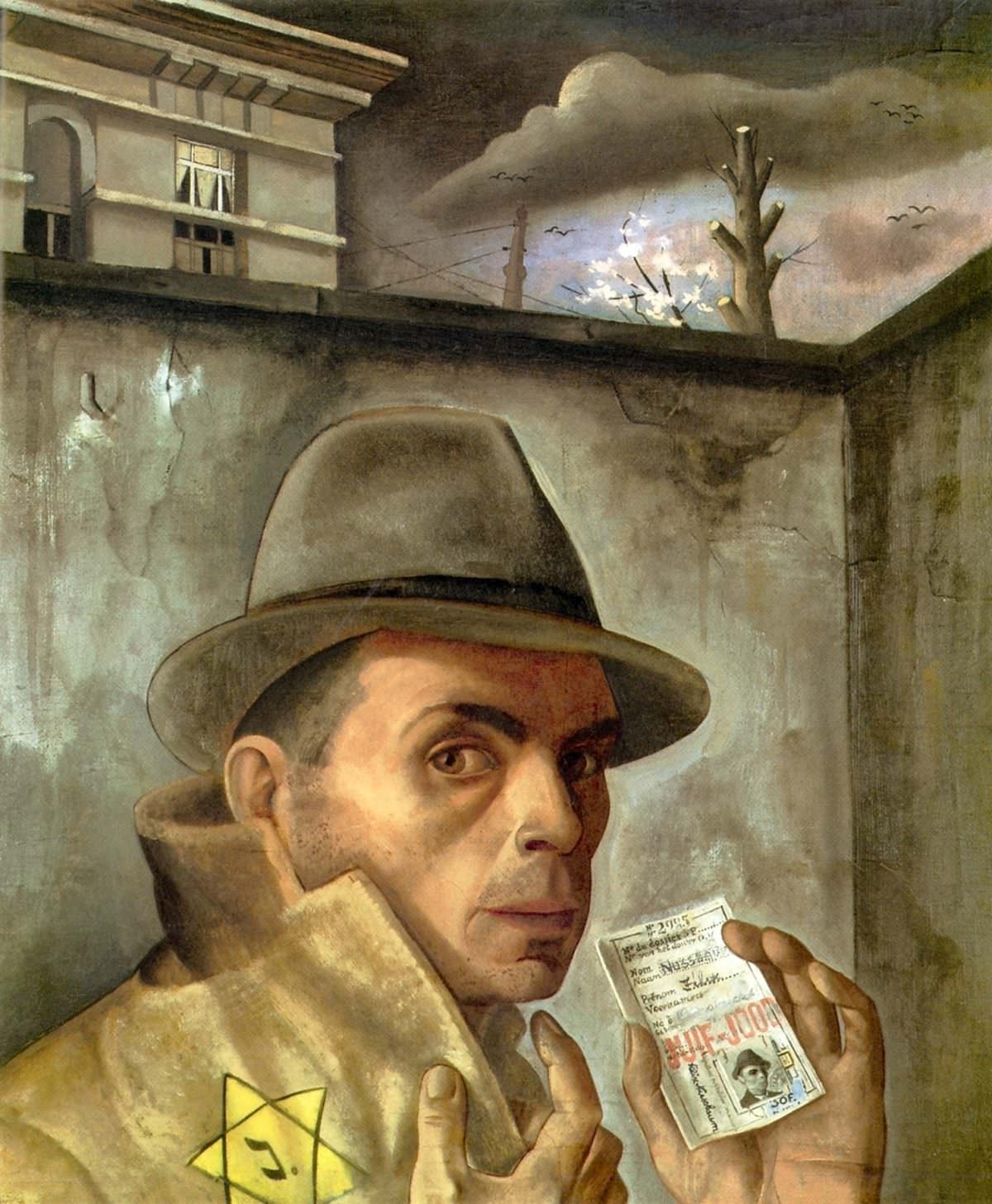
A wary, sideways glance meets the viewer as a man in a brimmed hat and heavy coat turns his shoulder, half-concealed against a stained wall. On his chest, the yellow Star of David badge is stark and unmistakable, pinned to fabric that seems to swallow light. In his raised hand he presents an identity card—small, official, and damning—transforming a self-portrait into evidence of how paperwork could define a life in 1943.
Behind him, the scene opens to an uneasy exterior: hard architectural edges, dark wires cutting the sky, and a bare, broken-looking tree reaching upward. The clouded background and distant bursts of light suggest a world under strain, where danger is not only personal but atmospheric. Details are rendered with careful realism, yet the composition feels staged like a confession, forcing the eye to move between face, badge, and document.
“Self-Portrait with Jewish Identity Card, 1943” belongs to the visual record of Jewish persecution during World War II, and it does so through intimacy rather than spectacle. The artist’s body becomes a contested space—marked, inspected, and recorded—while the act of holding up the card reads as both compliance and indictment. For readers searching for Holocaust-era art, wartime identity papers, and self-portraiture as testimony, this work offers a powerful entry point into how identity was weaponized and how art could answer back.