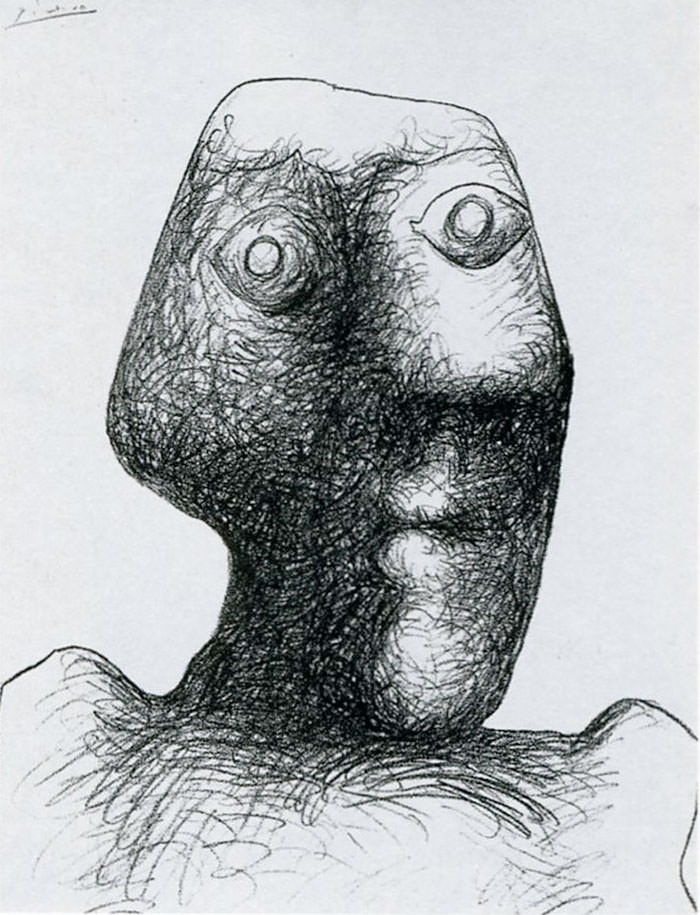
Dated July 3, 1972, the work posted under the title “90 years old” leans into a stark, unforgettable kind of portraiture. A large head rises from broad shoulders, the face simplified into heavy planes and deep shadow, with wide, circular eyes that fix the viewer in place. The background is left bare, as if the artist wanted nothing to soften the confrontation.
Ink-like lines accumulate in restless layers, building a dense field of crosshatching that reads almost like weathered skin or a lifetime of worry. One side of the face is swallowed by darkness while the other is held in pale light, creating a dramatic split that suggests memory, age, and endurance rather than conventional likeness. The mouth is reduced to a few tense marks, leaving expression ambiguous—part stoic, part haunted—yet undeniably human.
As an example of 1970s artwork and expressive drawing, this historical image speaks to how artists used distortion to tell the truth of experience. The piece invites slow looking: every scribbled strand and smudged contour becomes a record of time passing, perfectly echoing the post’s theme of being ninety years old. For readers searching for vintage art, aged portrait studies, or evocative black-and-white drawings, this scan offers a powerful glimpse into how aging can be rendered with nothing more than line, shadow, and nerve.