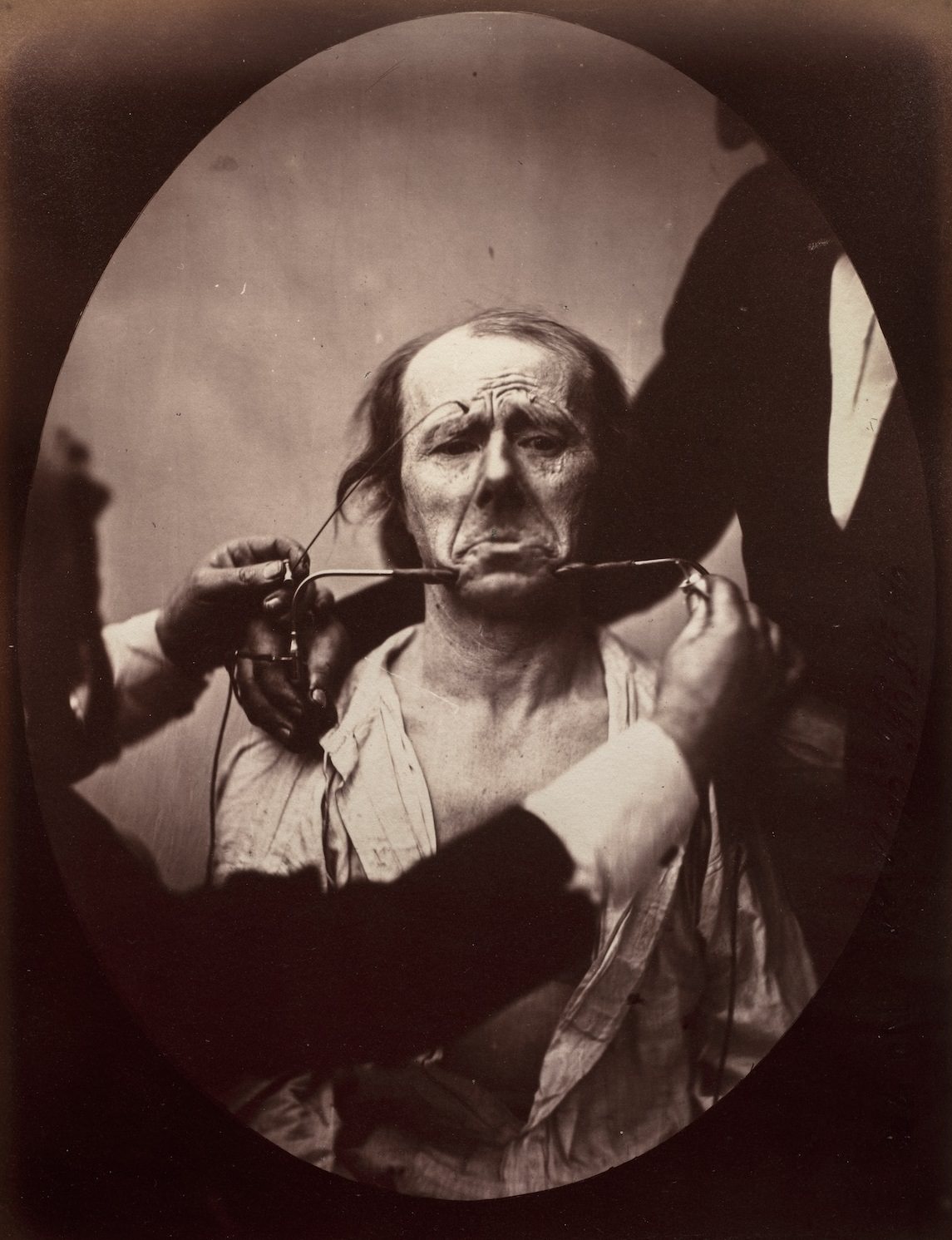
Under a stark studio light, a seated man’s face becomes an instrument of study—creased brow, tightened mouth, and hollowed cheeks arranged into an expression that looks both imposed and painfully human. Hands enter from either side to position thin wires and electrodes against the skin, turning the portrait into a record of experiment as much as a work of art. The oval framing and soft sepia tones lend the scene an almost theatrical intimacy, drawing the eye to every furrow and twitch.
Guillaume-Benjamin-Amand Duchenne de Boulogne’s *Mechanism of Human Physiognomy* sits at a fascinating crossroads of early photography, medical investigation, and the long history of attempts to “read” emotion in the face. Here, the camera does not merely observe; it collaborates with technique, capturing fleeting muscular contractions as evidence. For modern viewers, these physiognomy illustrations raise questions about objectivity, spectacle, and the ethics of using bodies to build knowledge.
Seen today, the photograph resonates beyond its original scientific aims, offering an unforgettable glimpse into how expression was mapped, classified, and visually staged. The contrast between the subject’s vulnerable stillness and the purposeful hands around him makes the image hard to forget, and it helps explain why Duchenne’s work continues to circulate in discussions of art history, psychology, and the origins of facial-expression research. If you’re exploring historical medical photography or the evolution of emotion studies, this post highlights a striking example that remains as unsettling as it is influential.