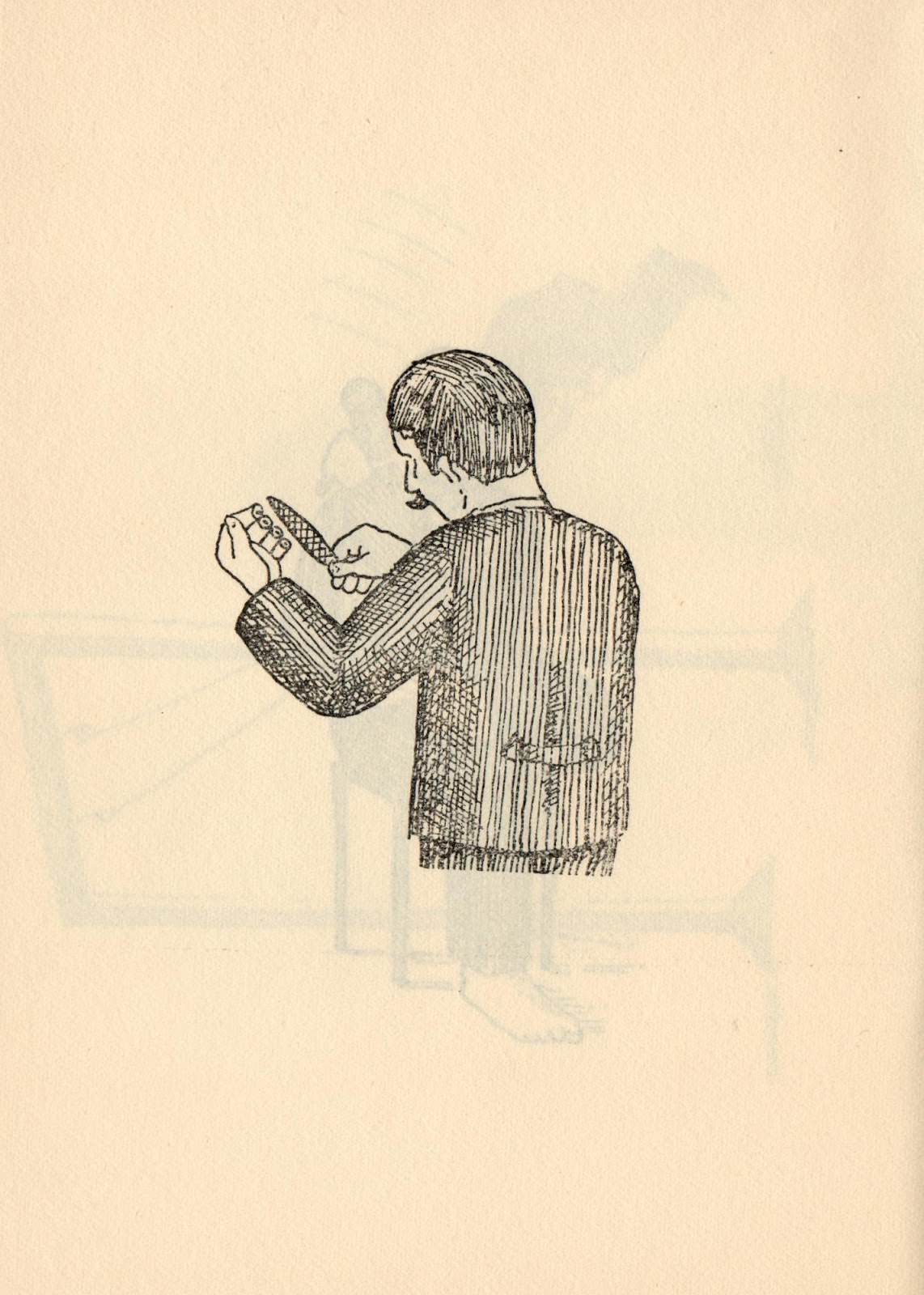
Against a wide field of blank paper, a solitary figure is rendered in crisp black ink, turned away from us as if guarding a private ritual. Tight hatching builds the texture of a jacket and hair, while the hands become the focal point—one held up as though presenting a palm, the other gripping a small blade-like object that hovers with unnerving intention. The spare composition leaves room for discomfort to grow, making the viewer supply the missing context that the line refuses to explain.
Roland Topor’s 1960 illustration, as framed by the title’s theme of masochism artworks, leans on understatement rather than spectacle. There is no dramatic background, only the quiet theatre of self-directed scrutiny, where suggestion does the heavy lifting and the gesture is more psychological than literal. The faint ghosting beneath the main drawing hints at an earlier sketch or printed trace, adding a layered, almost haunted quality that suits an artist interested in the uneasy overlap between desire, pain, and control.
Readers exploring surreal illustration, dark satire, and 20th-century graphic art will find this piece a potent example of how minimal lines can carry maximal tension. It invites a slower look at technique—crosshatching, negative space, and the careful tilt of posture—while also rewarding those searching for Roland Topor art and provocative mid-century illustration history. The result is less a scene than a question: what do we do with the impulse to turn suffering into form, and why does the page make it feel so intimate?