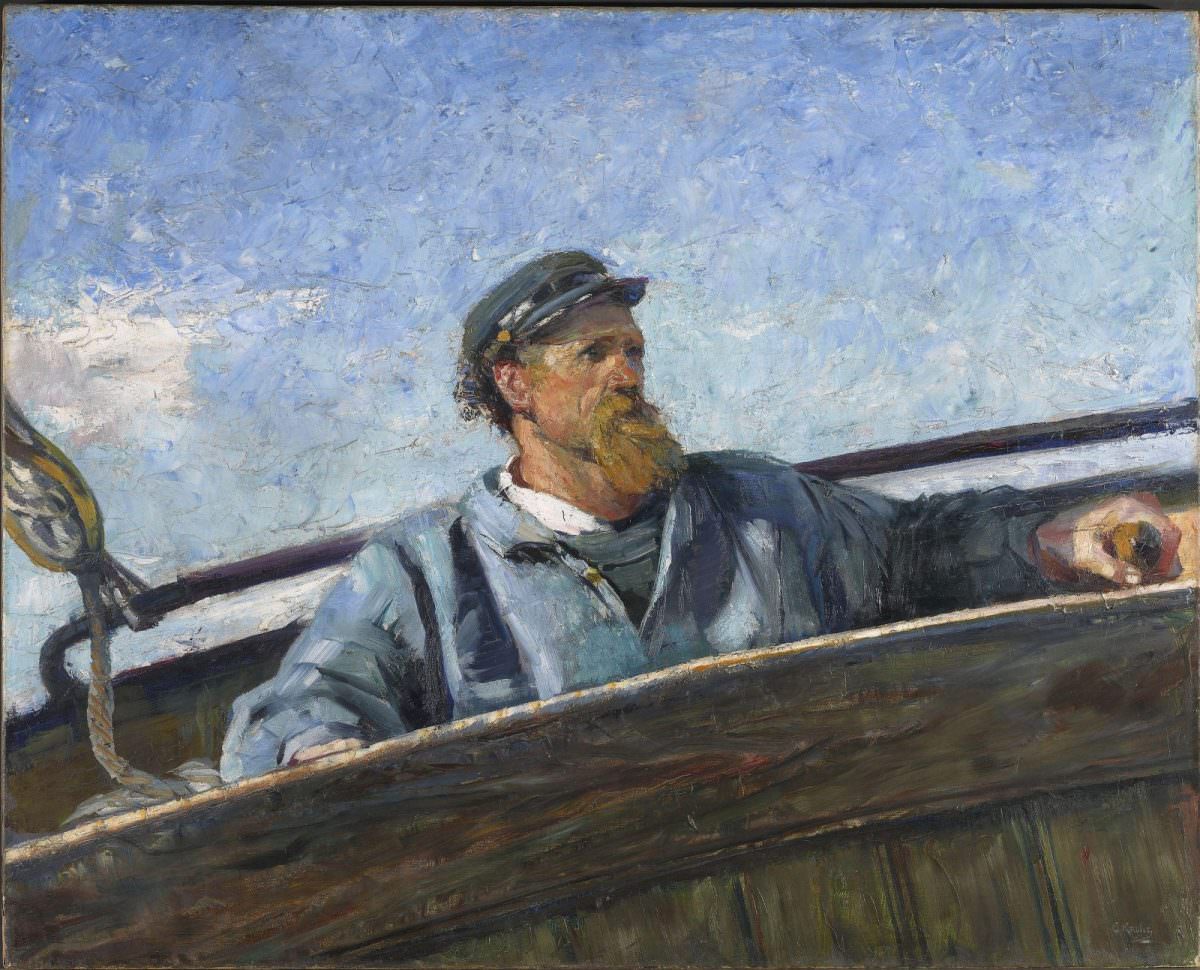
North Wind, 1887 places a solitary sailor in the foreground, his weathered face and ginger beard turned into the gusts as if measuring them by instinct. A dark cap hugs his head, and his heavy blue clothing reads as working gear rather than costume, suggesting the hard routine of life afloat. The composition keeps the horizon out of reach, letting the broad sweep of pale sky carry the mood—open, cold, and impatient.
Brushwork does much of the storytelling here: thick, lively strokes roughen the sky into moving air, while the boat’s wooden edge cuts a steady diagonal across the scene. A coil of rope and the suggestion of rigging hint at labor just outside the frame, and the man’s braced posture—one arm set along the rail—signals both balance and endurance. The limited palette of blues, browns, and muted flesh tones reinforces the title’s chill, as though the wind itself has washed the world in cold light.
As an artwork rooted in the late 19th century, this seafaring portrait speaks to an era when maritime work shaped economies and imaginations, and artists increasingly sought truth in ordinary professions. Rather than romantic spectacle, the focus is on atmosphere and character: salt, sky, and steady attention to the elements. For readers searching historical art, nautical painting, or 1887 artworks, North Wind offers a vivid, human-scale encounter with the sea’s stern weather.