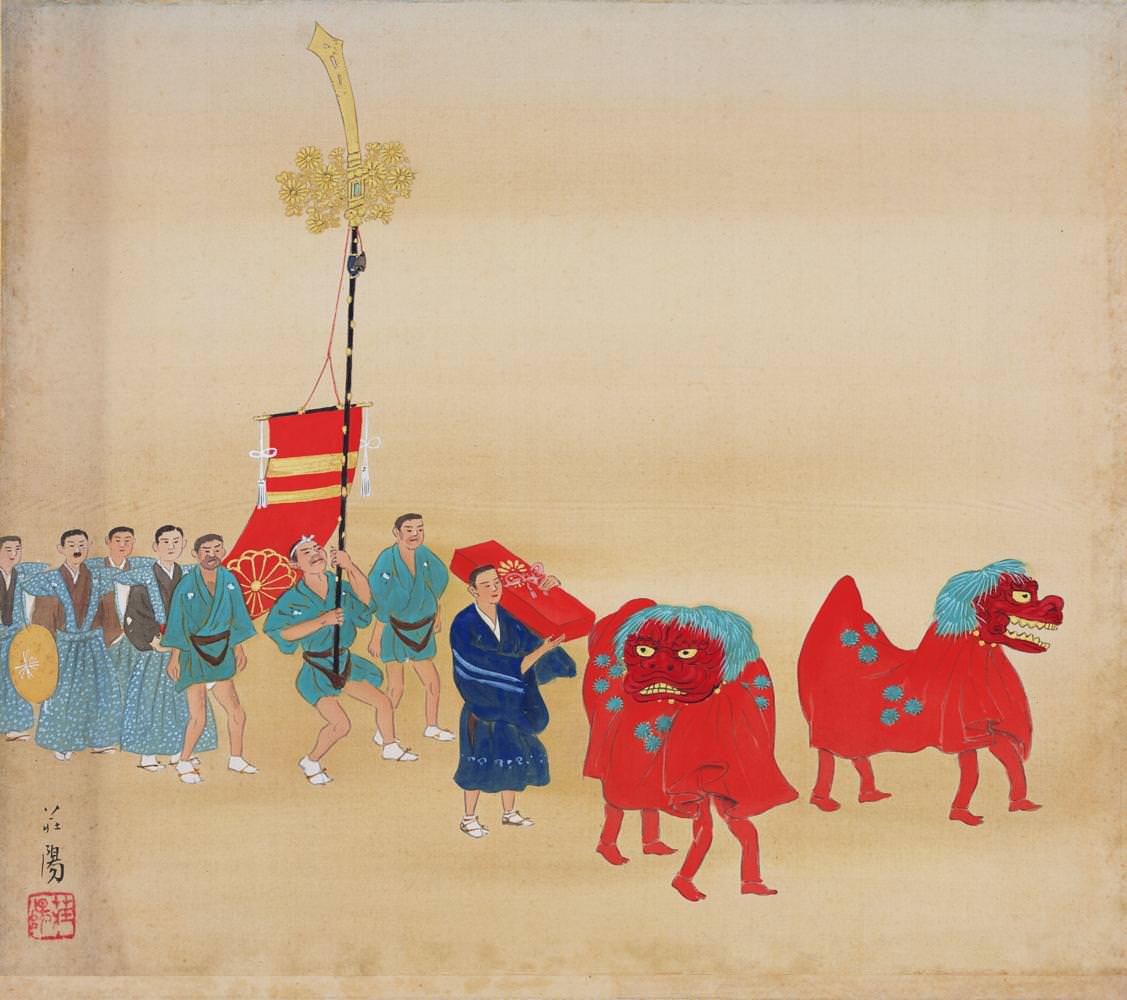
A sweep of pale sky leaves room for the procession to breathe, letting the festival figures move across the silk with an almost theatrical clarity. In the foreground, two vivid red lion costumes—shishimai—stride forward, their painted faces fierce and playful at once, while attendants in blue and patterned robes keep pace. Behind them, a tall standard topped with a decorative finial rises above the group, adding a vertical accent that anchors the scene and hints at ceremonial order.
Color does much of the storytelling here: vermilion bodies, teal-blue garments, and small floral motifs punctuate a restrained background, suggesting how Kyoto’s Miyako festivals balanced splendor with elegance. The brushwork favors clean outlines and flat, confident fields of pigment, a style that suits festival imagery where costumes and props carry meaning. Even without crowding the frame, the artist conveys soundless rhythm—footsteps, music, and the coordinated labor of carrying banners and offerings.
For collectors and readers interested in 1920s Japanese artwork, these silk paintings offer an intimate window into Kyoto’s celebratory culture and the visual language of traditional performance. The composition’s open space and careful detailing make it ideal for close viewing, where one can appreciate textiles, emblems, and the spirited character of the lion dance. As a WordPress feature, the piece also serves as a strong SEO-friendly spotlight on Kyoto festival art, Miyako traditions, and Japanese silk painting from the early twentieth century.