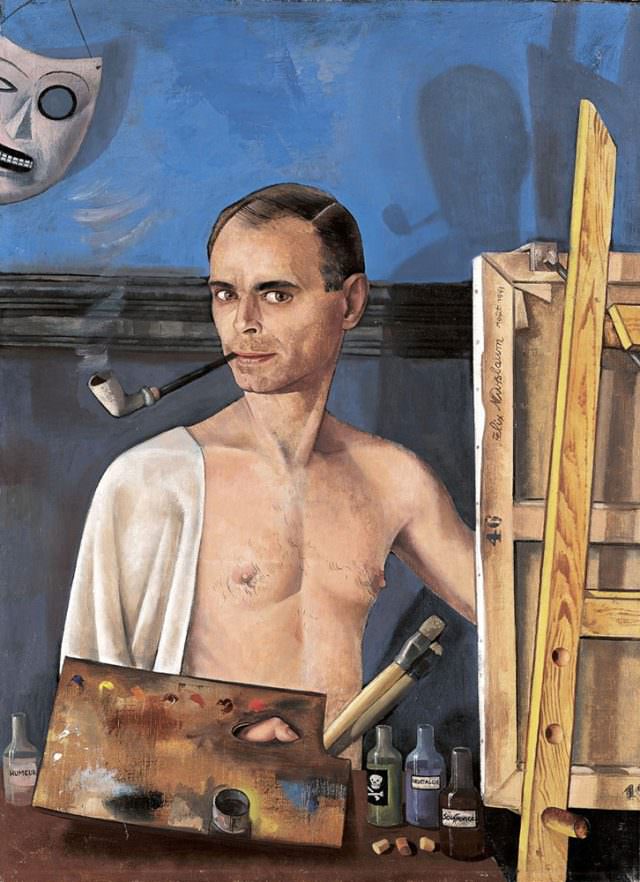
Painted as a self-portrait in 1943, the work confronts the viewer with an artist who looks outward while staying firmly inside the studio. A bare chest and a casually draped white cloth suggest vulnerability and candor, yet the steady gaze and the pipe held at an angle add a note of composure. The cool blue wall behind him flattens the space just enough to keep the focus on the face, where sharp modeling and restrained expression do the heavy lifting.
Around the figure, the tools of painting become part of the narrative: a well-used palette, brushes, bottles of mediums and pigment, and the solid geometry of an easel and stretched canvas. The setting reads like a quiet inventory of practice—workmanlike, intimate, and lived-in—placing “artworks” in the realm of daily labor rather than distant genius. Even the visible texture and marks imply process, as if the painter wants you to notice the making as much as the made.
In the upper left, a mask-like head intrudes with an uncanny, theatrical presence, turning the studio into a stage for identity and performance. That uneasy corner detail complicates the straightforward honesty of a self-portrait, hinting at the personas an artist tries on, discards, or fears in the midst of work. For readers interested in historical art, wartime-era self-portraiture, and the symbolism of the artist’s studio, this 1943 painting offers a compact, unforgettable study of self, craft, and the shadows that gather at the edge of the canvas.