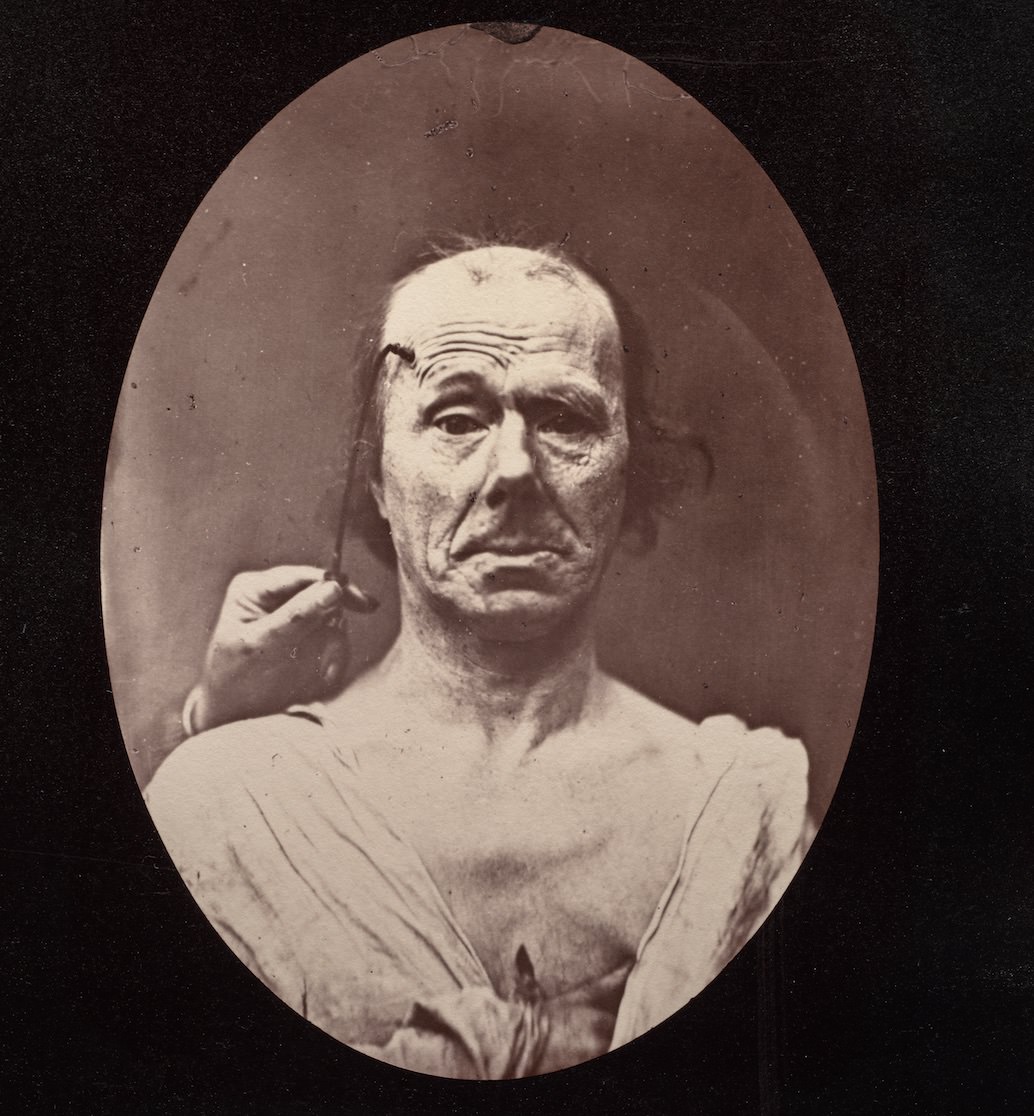
A stark oval portrait confronts the viewer with an older man posed bare-chested, his expression tightened into a controlled grimace as if feeling for the very edge of pain or sorrow. The background is plain and dark, pushing every crease of the brow, every pull at the mouth, into sharp relief. Even the photograph’s age—soft focus, surface marks, and the warm tonality of an early print—adds to the sense that this is both a record and an experiment.
Guillaume-Benjamin-Amand Duchenne de Boulogne’s “Mechanism of Human Physiognomy” sits at the crossroads of art history and medical history, where the face becomes a map of muscles and meaning. Here, the visible presence of a hand near the subject’s head hints at intervention rather than a simple sitting, suggesting the deliberate staging behind these famous physiognomic studies. The result is unsettling and mesmerizing: emotion rendered not as a fleeting feeling, but as a measurable configuration.
Readers drawn to early photography, anatomical illustration, and the origins of facial-expression research will find these images rich with story and controversy. They reveal how nineteenth-century science tried to translate inner life into outward form, and how photographic realism could be marshaled to argue for theories of the human body. In a WordPress gallery or feature post, this piece works beautifully as a conversation starter about physiognomy, experimentation, and the enduring power of a single captured expression.