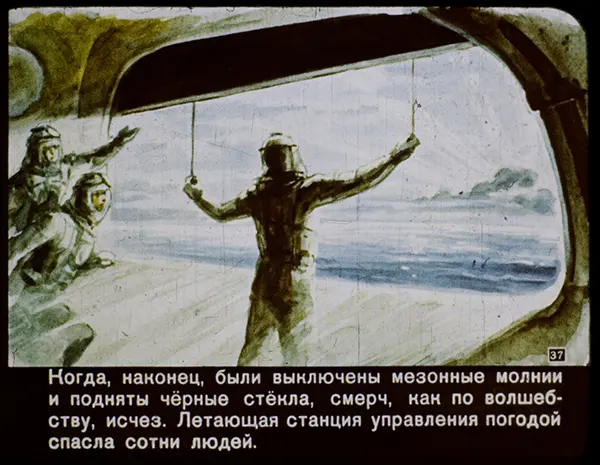
A wide, curved observation window frames a turbulent horizon while a helmeted operator stands at the controls, arms raised as though conducting the sky itself. Behind him, bundled figures press close to the interior wall, their faces turned toward the glass with a mix of tension and awe. The composition reads like a mid-century vision of disaster response—part cockpit, part command center—set inside a craft built to confront the most violent weather.
Across the lower margin, Cyrillic text anchors the scene in the tradition of Soviet-era illustrated science and popular futurism, where bold claims and dramatic visuals worked together to make technology feel heroic. The title’s talk of “meson energy” and “black glass” suggests a speculative mechanism: shielding lowered, power cut, and nature abruptly calmed, as if science could pull a lever and silence a storm. Even without pinpointing an exact time or place, the poster-like layout and simplified forms evoke an age when spaceflight aesthetics bled into dreams of controlling Earth’s elements.
For WordPress readers interested in historical artwork, retro sci‑fi illustration, or the cultural history of weather prediction, this piece offers plenty to linger over. It stages meteorology as a life-saving mission and casts the “flying weather station” as both machine and myth, a mobile fortress watching the clouds. The result is a vivid, SEO-friendly glimpse into how past generations imagined extreme-weather technology—part warning, part promise, and entirely cinematic.