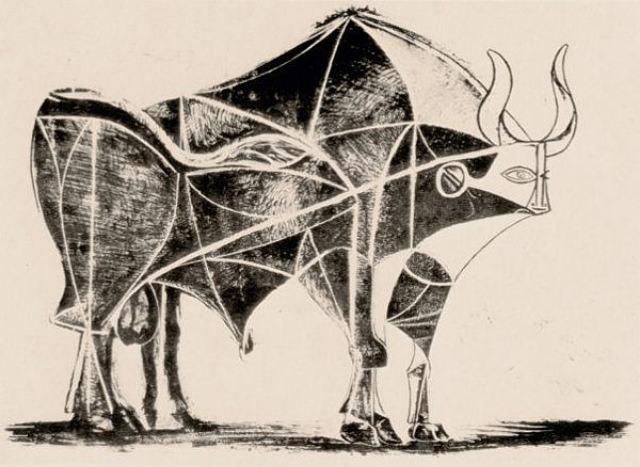
Plate 5 pushes the subject into a bold economy of line, where the animal’s body is rebuilt from intersecting angles and confident contours. Broad dark fields sit beside pale, scratched highlights, turning muscle and hide into a mapped surface of planes and edges. The horns, eye, and muzzle remain readable, yet everything around them has been pared down into a graphic structure that feels both analytical and expressive.
Across the torso, crisscrossing white strokes suggest a framework—part anatomy lesson, part design blueprint—while the legs are simplified into sturdy verticals that anchor the figure. The background is left largely blank, so the stylized creature dominates the space like a sign or emblem rather than a scene from life. That intentional emptiness amplifies the sense of abstraction, inviting the viewer to focus on form, rhythm, and the balance of black and white.
For readers interested in modernist art studies, printmaking, and the process of simplification and stylization, this artwork offers a clear snapshot of reduction as a creative method. It speaks to the way artists can preserve identity with only a few essential marks, transforming a familiar animal into an icon of shape and motion. As part of an “Artworks” post, Plate 5 becomes a compact lesson in visual language—how meaning survives even as detail disappears.